



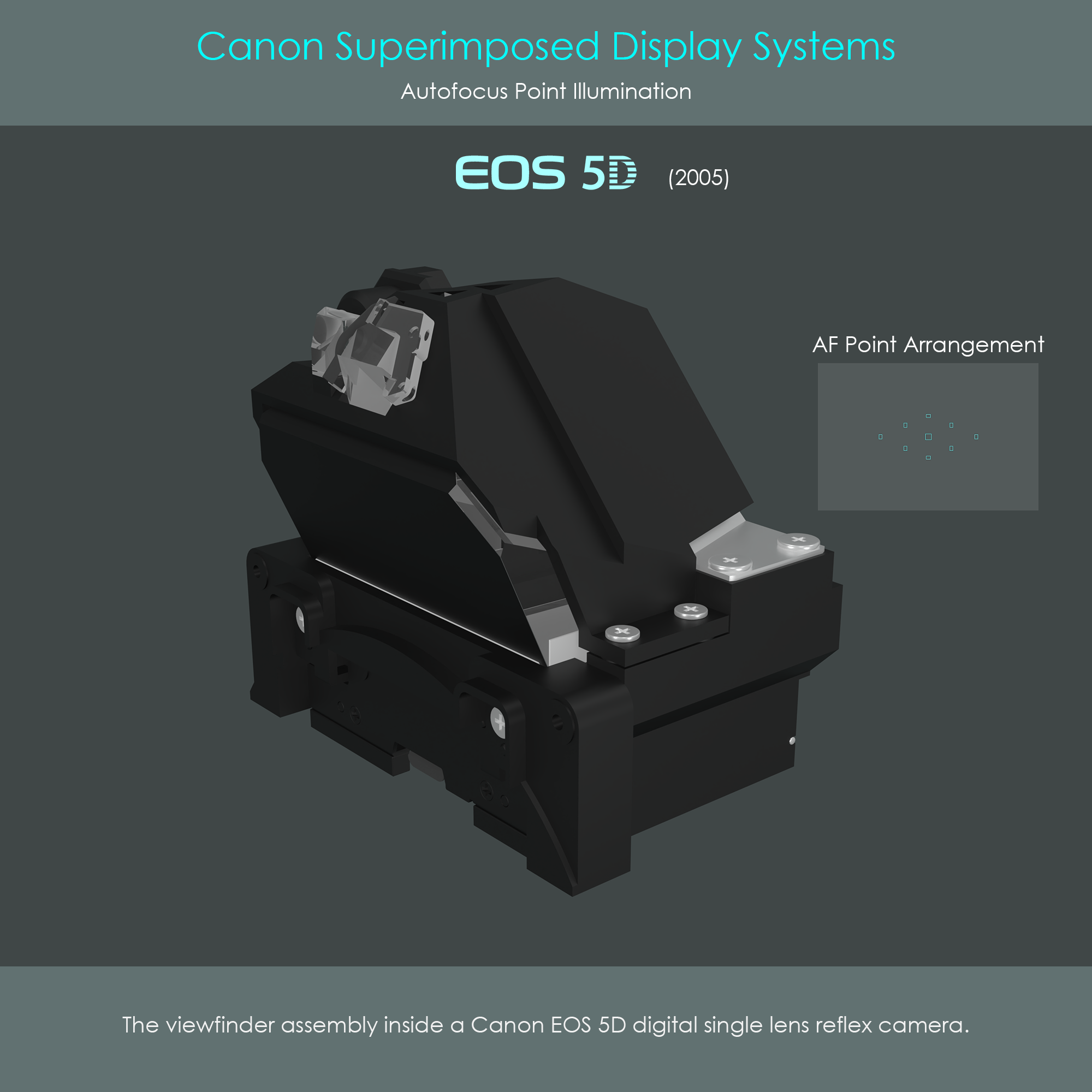
The Canon EOS 5D is a full-frame DSLR camera that was released in 2005. The camera's viewfinder is equipped with nine AF frames arranged in a diamond pattern, and each of them can be lit up individually. The camera's AF point illumination system uses an array of nine LEDs positioned on the upper rear of the pentaprism to shoot beams of light through two SI prisms and through the pentaprism itself. Light is projected in the configuration of the AF points on the reflective surface of the SI screen between the pentaprism and the focusing screen.
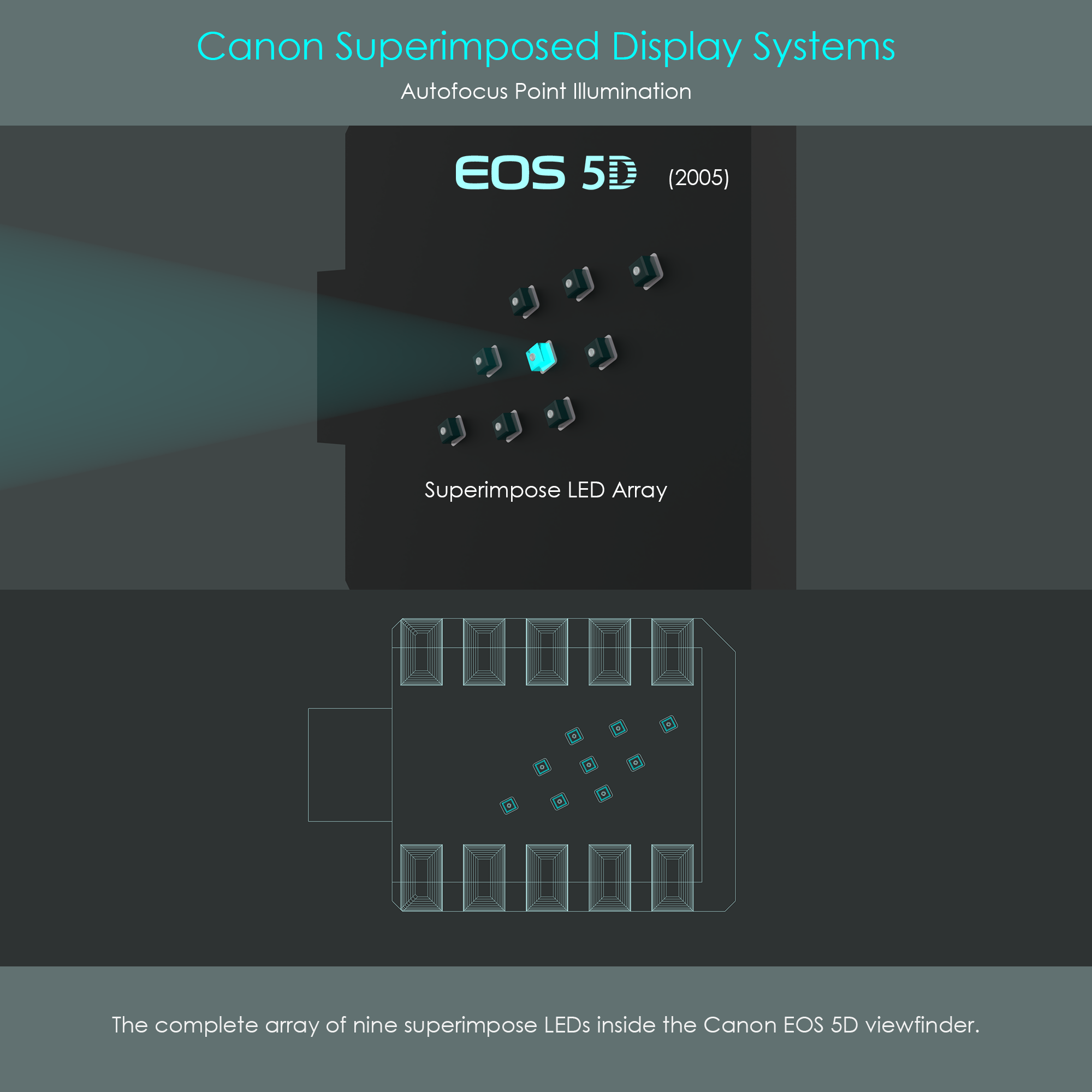
The Canon EOS 5D uses an innovative array of nine chip-on-board micro LEDs. The actual electroluminescent semiconductor material is bonded directly onto a shared substrate. These red light-emitting diodes are absolutely microscopic in size: They have a square footprint with a side length of 0.25 mm. Nine of these micro LEDs are arranged on the substrate in an identical diamond configuration as the AF frames in the viewfinder. Tiny bond wires are connecting each LED's top contact to the board (not seen in this diagram). The substrate has wire traces integrated to ensure independent addressability of each micro LED (via common anode). This light unit is connected to the camera's viewfinder electronics via a 10-line flexible PCB.
The SI LED array as well as the SI prisms 1 and 2 of the EOS 5D's SI display system are attached to a support structure. The support structure is designed to perfectly sit on top of the pentaprism and is screwed to the pentaprism socket.
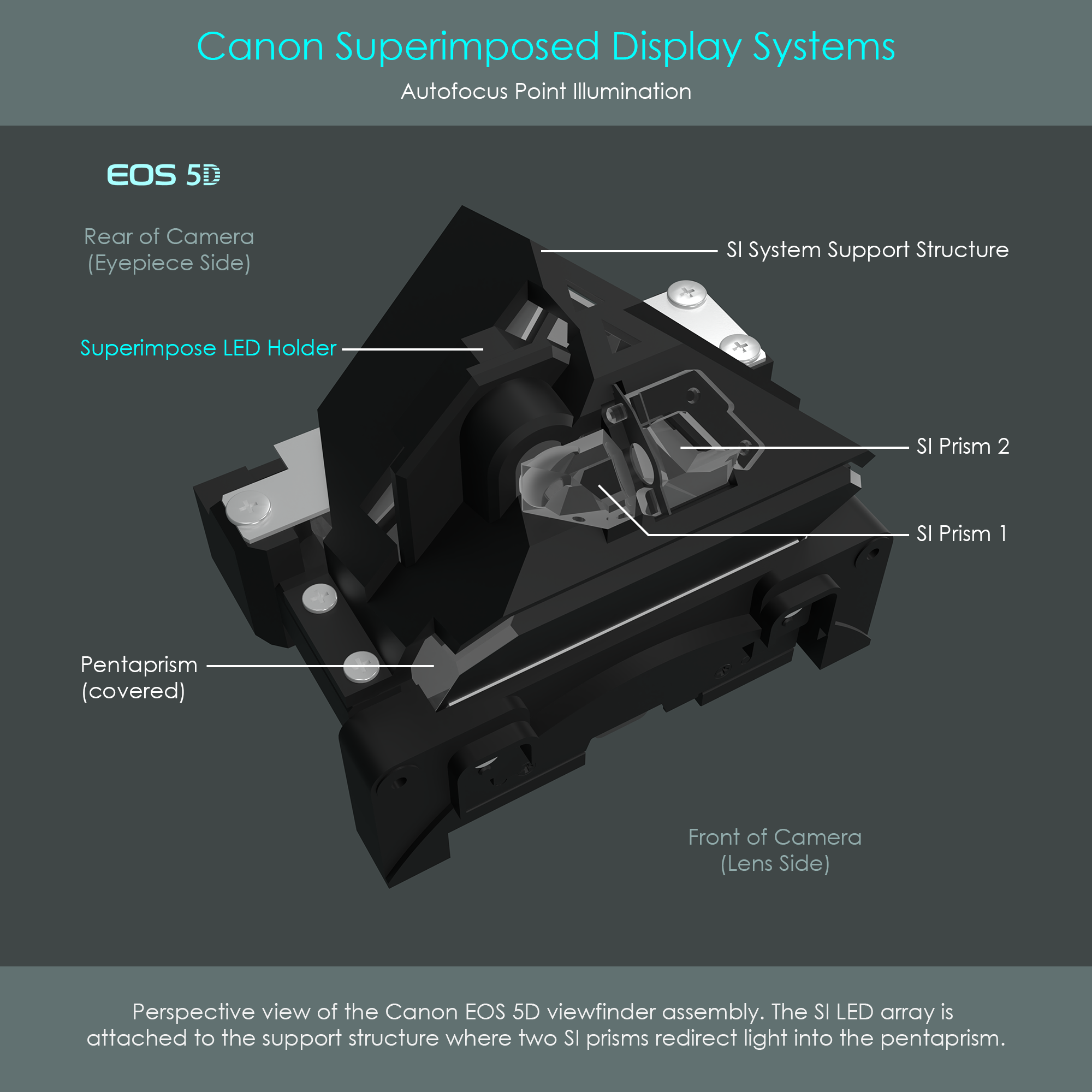

Looking at a cutaway diagram of the same viewfinder unit, the SI screen and the focusing screen are revealed. The SI screen is an acrylic plate and has the nine reflective AF frames engraved on the lower surface. The SI screen is almost touching the focusing screen (there is just a thin spacer placed between these two plates) to ensure that the AF frames appear to be at the same position as the preview image that is projected onto the focusing screen. The SI screen has an anti-reflective coating applied to its surfaces to prevent it from darkening the viewfinder image. If you want to learn more about the physics behind anti-reflective coatings, check out this article.

Here is a top view of the EOS 5D's SI display system, but only optical elements are shown to better visualize the paths of light. All SI LEDs are energized. Once an AF frame lights up in red, it can be seen very clearly through the eyepiece. On closer inspection, it is noticeable that the entrance and exit surfaces of SI prism 1 are shaped into small lens surfaces. The curvature of the entrance surface is rather noticeable while the curvature of the exit surface is extremely low. These curved surfaces allow SI prism 1 to behave like a biconvex lens, projecting light from each SI LED onto the SI screen at the correct position.
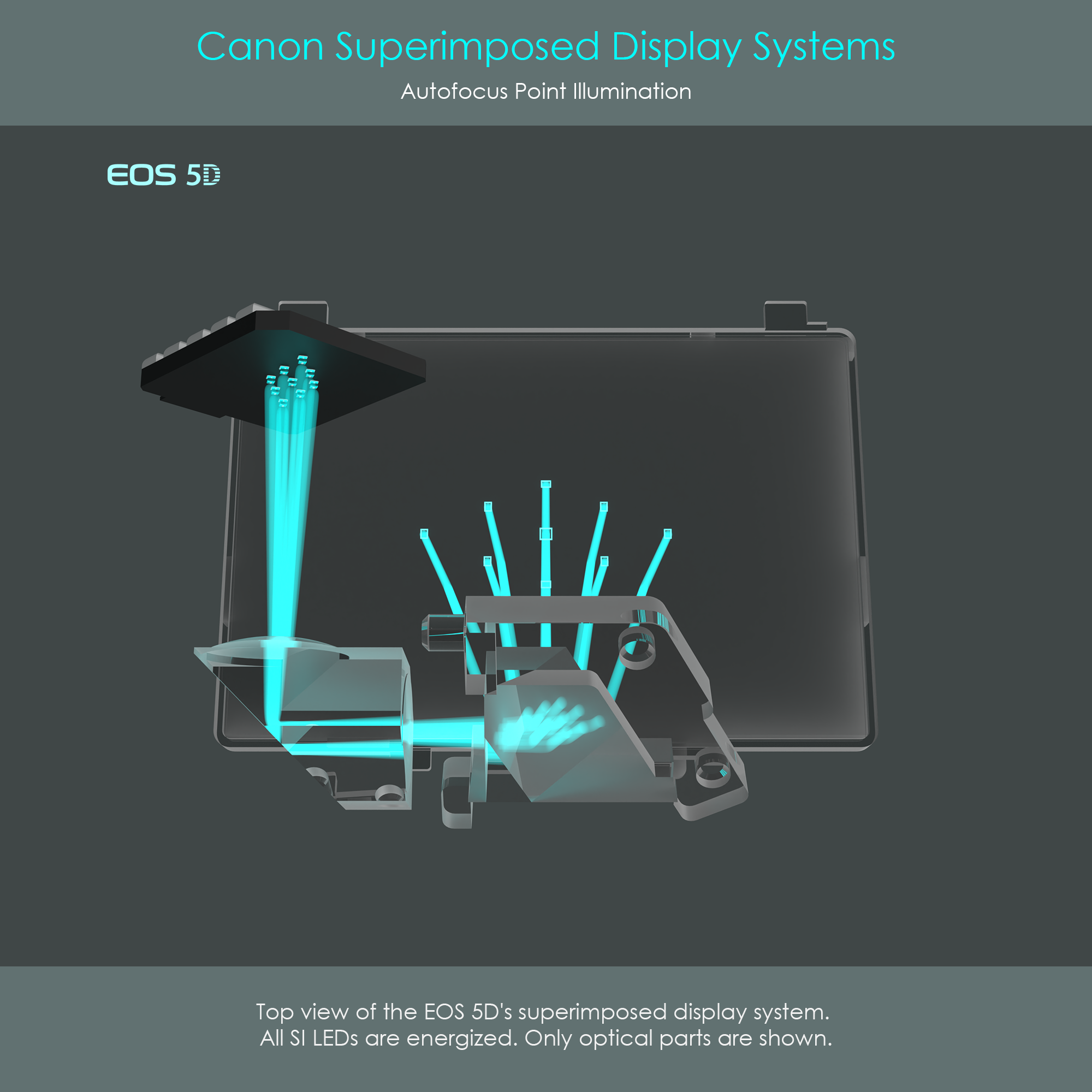

Here is another perspective of the EOS 5D's SI display system. It is interesting to see that the LED array is not arranged exactly vertically, but deviates from the vertical at a very specific angle. This positioning of the LED array is necessary because the surface angles of the two SI prisms cause the beam arrangement to rotate. The animation toggles through all the AF frames.
Here is another view of the SI display system, but only optical elements are shown to better visualize the paths of light. The animation toggles through all the AF frames.
Below is an animated view of SI prisms 1 and 2 to better visualize the complex geometries of these optical elements.