



The Canon EOS 7D is an APS-C DSLR camera that was released in 2009, and it used an entirely new concept to display information in the viewfinder. Instead of having AF frames and lines permanently engraved into an SI screen or the focusing screen, the EOS 7D uses a transmissive liquid crystal display (LCD) above the focusing screen. This LCD screen allows a variety of information to be displayed right on the camera's focusing screen. This design is called a transmissive LCD viewfinder or intelligent viewfinder. The EOS 7D's viewfinder can show (or hide) the following information:
The intelligent viewfinder in the Canon EOS 7D was a significant innovation for several reasons. The technology bridged the gap between traditional optical viewfinders (OVF) and the data-rich experience of electronic viewfinders (EVF), without sacrificing the speed and clarity of an all-glass pentaprism. An intelligent viewfinder can display the information that is truly needed and completely hide unnecessary information (such as unused autofocus points), so that the viewfinder image is not disturbed. In addition, to use viewfinder grid lines, conventional cameras required to physically replace the focusing screen with another version that had grid lines engraved. With the built-in transparent LCD overlay of the Canon EOS 7D, this is no longer necessary, as viewfinder grid lines can simply be enabled via a camera setting.
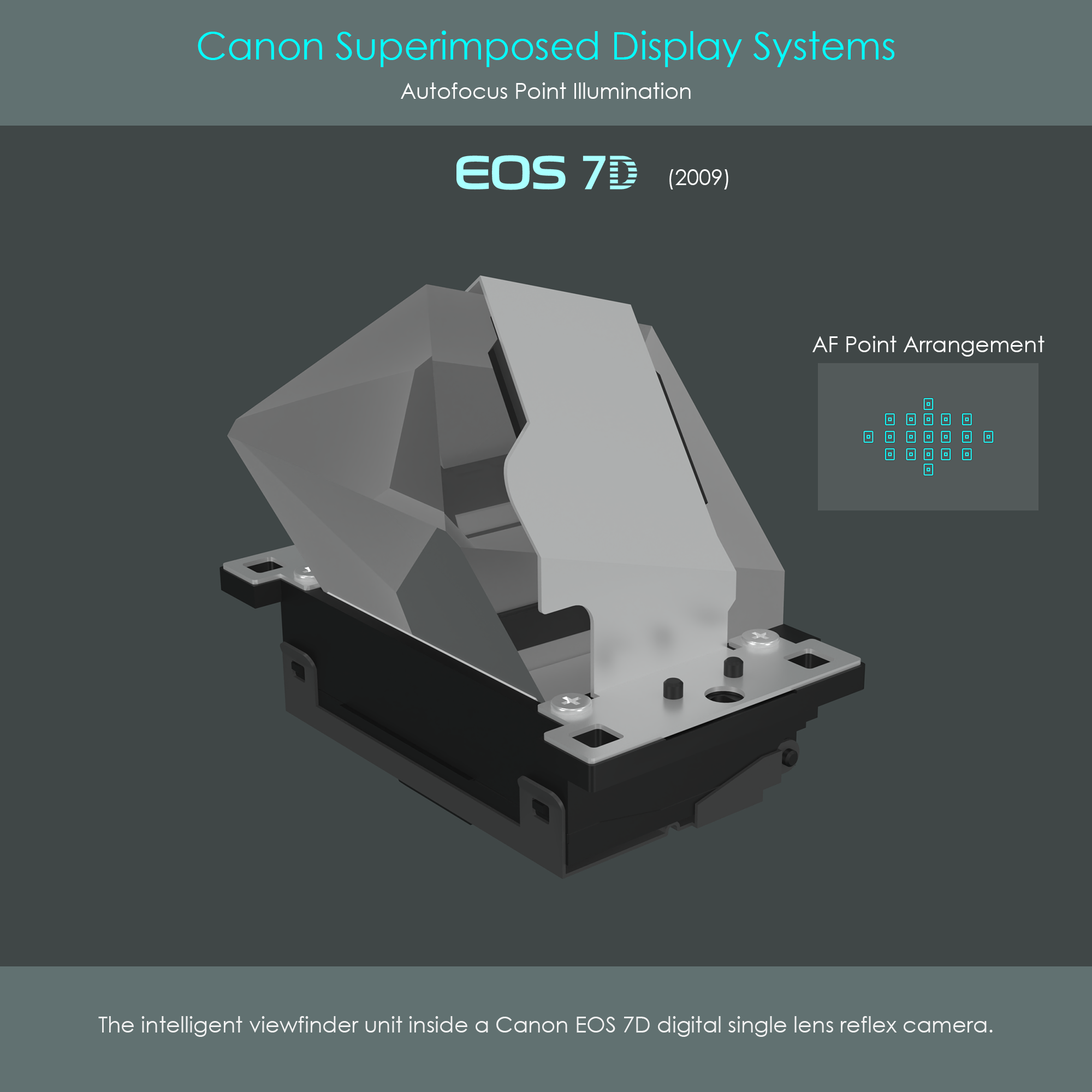


The camera's AF point illumination system uses four powerful surface-mounted device LEDs emitting red light. The LED package is sized 1.6 mm × 0.8 mm. The actual light emitting device is encapsulated in a clear epoxy mold sized 1.2 mm × 0.8 mm.
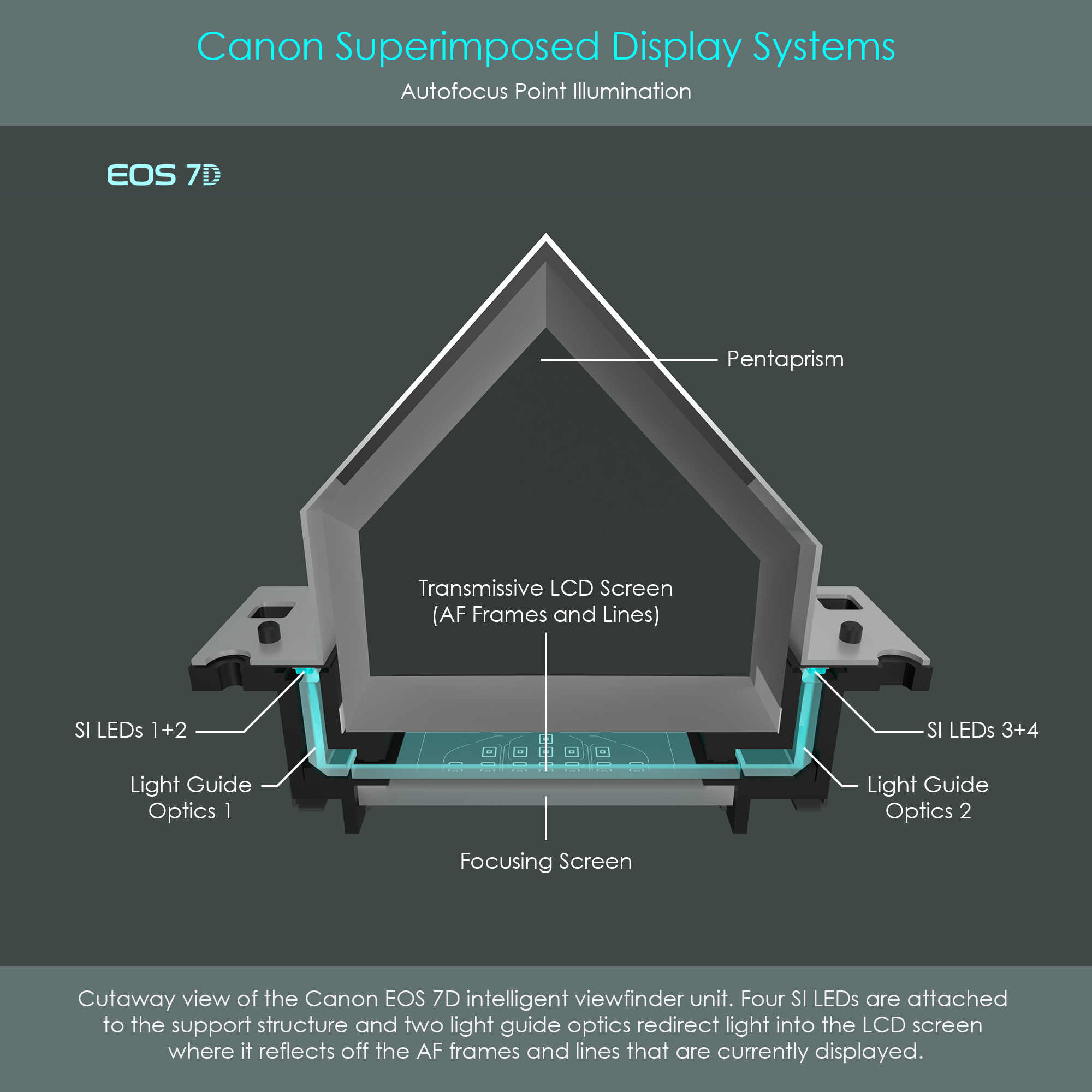
The SI LEDs are positioned inside the pentaprism socket in two groups, pointing downwards at two light guide optics channeling light into the LCD screen. Light passes through the LCD plate and ultimately lights up all features that are currently displayed. The diagram is a cross-sectional view of the viewfinder unit seen from the front of the camera.
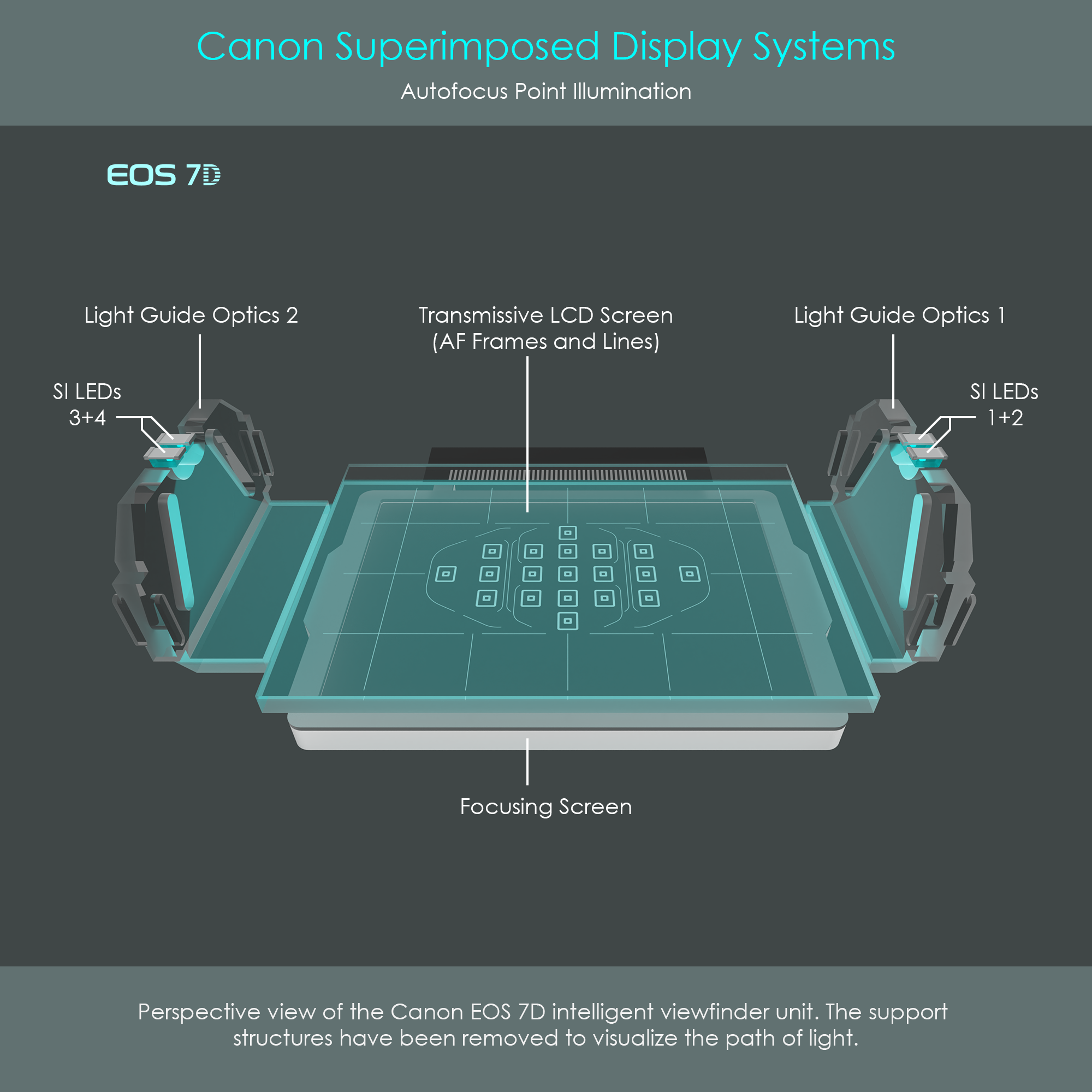
Here is another perspective of the intelligent viewfinder where only optical elements are shown. The LCD is driven via 52 electrical contacts which allow the camera electronics to address every individual feature on the screen (such as AF frames or lines). If a feature is not activated, the display is completely transparent at that location. This is an advantage over the previous camera generations where all AF frames have always been visible in the viewfinder even if they were not used.
As long as there is no voltage applied to the device, this type of LCD appears like frosted glass and is therefore non-transparent. For that reason, with the camera's battery removed or empty, the EOS 7D's viewfinder no longer displays the preview image and turns very dark. Once a charged battery is inserted again, the viewfinder LCD turns fully transparent, showing a clear preview image again, even when the camera is turned off. This effect does not consume any noticeable amount of power, as the effect is primarily based on the electric field of the battery's voltage (and only on exceptionally low electric current).
The illustration is a closer view of the light guide optics and visualizes the propagation of light inside the components.

Here is a top view of the EOS 7D's intelligent viewfinder with the pentaprism and other support structures removed. The animation toggles through some of the options the LCD can display.