



The Canon EOS-1D Mark IV is an APS-H DSLR camera that was released in 2009. The camera's viewfinder is equipped with 45 AF frames arranged in an oval configuration, and each of them can be lit up individually. The camera's AF point illumination system uses a strong light source located inside a specialized projection unit that is installed in front of the pentaprism.

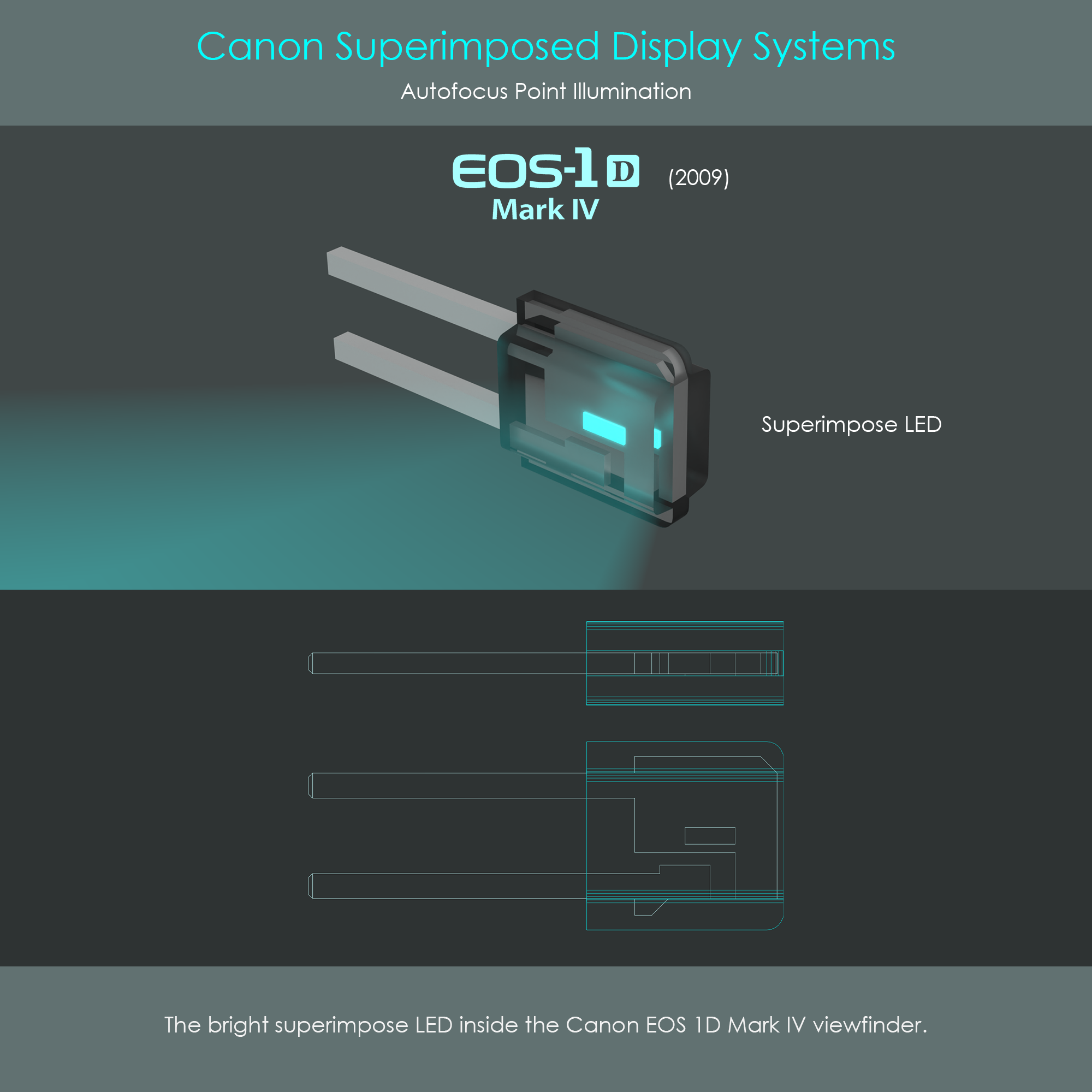
The camera's SI system uses a powerful red light-emitting diode. The LED has a large-area emitter placed on a metal frame and emits light sideways. The semiconductor material is encapsulated in a clear epoxy package. Once the two parallel connecting pins are energized, the LED produces an intense flood beam of light.
The projection system consists of various precisely arranged optical elements. Light from this projection system does not travel through the pentaprism or towards the focusing screen. Instead, the SI display system projects the AF frames into the user's field of view. The SI dichroic mirror is installed at an angle so that light that originates from the SI projection unit is reflected towards the eyepiece. A special feature of the SI dichroic mirror is that it is highly transparent to light from the focusing screen and pentaprism, and highly reflective to light from the SI LED which emits a very narrow wavelength of red light. While the user can still see the preview image on the focusing screen in the usual way, the dichroic mirror creates the illusion of the AF frames being positioned at the focusing screen itself.
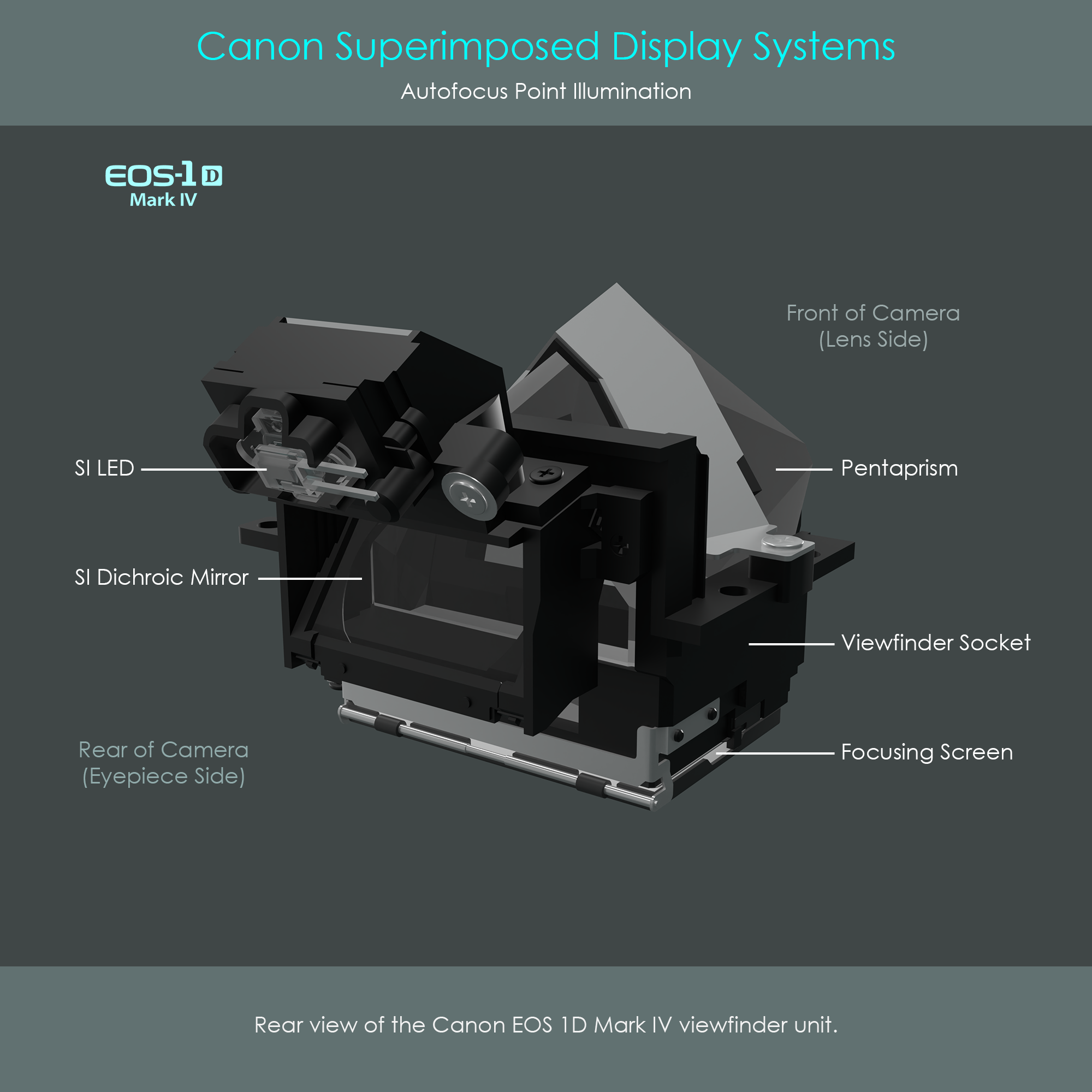

Light from the SI LED is passed through two dome lenses (SI dome lens 1 and 2) before passing through the SI LCD. These two dome lenses are used to collimate the beam of light which aligns the light rays almost parallel to each other. This step is required to ensure a sharp, uniformly illuminated, and properly focused projection of the AF frames. Light then travels through the SI LCD which has the translucent AF frames embedded, then passes through two SI lenses and ultimately gets reflected towards the eyepiece by the dichroic mirror. This creates the impression that the red AF frames appear exactly at the level of the focusing screen.
This type of projection is also known as Pepper's Ghost, and it is a classic optical illusion used to make objects or actors appear, disappear, or morph by reflecting them off angled glass. It is most famously used in theme parks (Disney's Haunted Mansion), concerts to create holograms of performers, theater productions, movies, museums, and displays.

The following illustration is an exploded view of the EOS-1D Mark IV viewfinder unit including the superimpose display projection system.
It should be noted that the Canon EOS-1D Mark IV does not have any AF frames engraved into the focusing screen. The only permanent markers applied to the focusing screen are the spot metering circle and an oval frame surrounding the autofocus area. Therefore, when the superimpose display system is inactive, the camera's viewfinder does not exhibit any black AF frames like various other camera models. Instead, the focusing screen is clear as long as no AF frame lights up, and red AF frames appear at the AF positions when the SI system activates (e.g. the AF frame which achieves focus will quickly flash in red).


Here is a closer view of the SI LCD. It can be seen that the LCD is mostly opaque but it exhibits transparent frames at every relative position where the system can display an AF point. Applying a voltage to the LCD turns individual AF frames opaque. During operation of the camera, all AF frames are opaque as long as no AF frame is illuminated. Once an individual AF frame (or all of them) is illuminated, the camera electronics energize the SI LED, and de-energize certain (or all) AF frames on the SI LCD. This will allow light to pass through the transparent AF frames on the LCD and reach the dichroic mirror, where the SI light superimposes the light from the pentaprism.
Here is a view of the superimpose display system as seen through the camera's eyepiece. All AF frames are transparent and the SI LED flashes in the animation.

Here is another perspective of the viewfinder but only optical components are shown. This clarifies which parts are actually involved in the AF point illumination. The SI LED flashes in the animation and rays of light are shown for each available AF frame.