



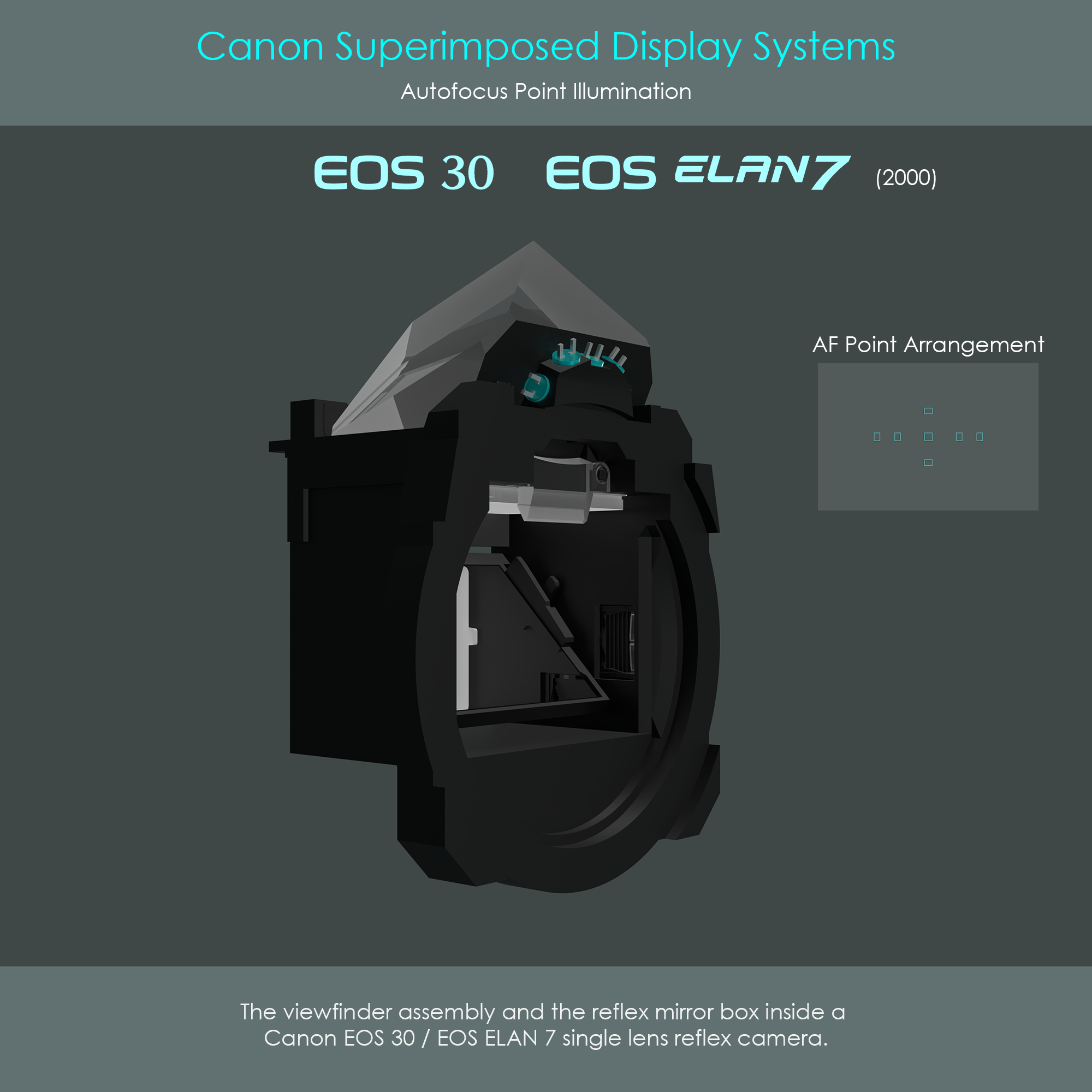

The Canon EOS 30 (called EOS 7 in Japan, and EOS ELAN 7 in North America) is a 35mm film SLR camera that was released in 2000. The camera's viewfinder is equipped with seven AF frames arranged in a cross configuration, and each of them can be lit up individually. The camera's AF point illumination system uses five LEDs located behind the pentaprism and two LEDs next to the mirror box to shoot beams of light into the direction of the reflex mirror. Light then reflects off the reflex mirror and is directed towards the individual AF frames engraved into the focusing screen. A unique detail of the EOS 30 is that it uses three SI prisms to redirect light from the SI LEDs towards the reflex mirror.
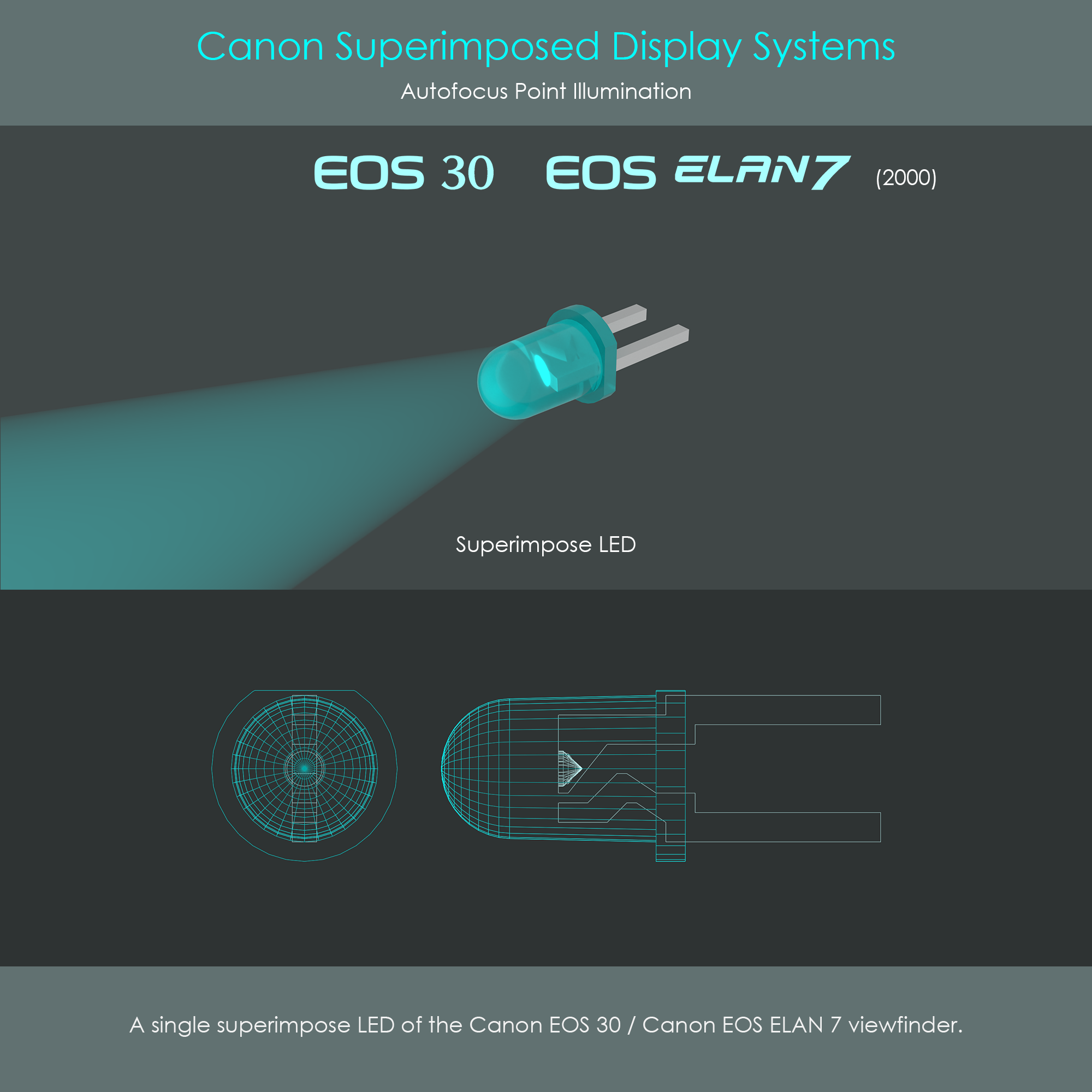
The camera's SI system uses seven 3.0 mm LEDs emitting red light. The LED chips are encapsulated in an epoxy package with two parallel connecting pins (cathode and anode), which is a popular format called a dual-in-line package (DIP). The front of the epoxy package is shaped into a small lens to create an intense and directional radiation pattern.
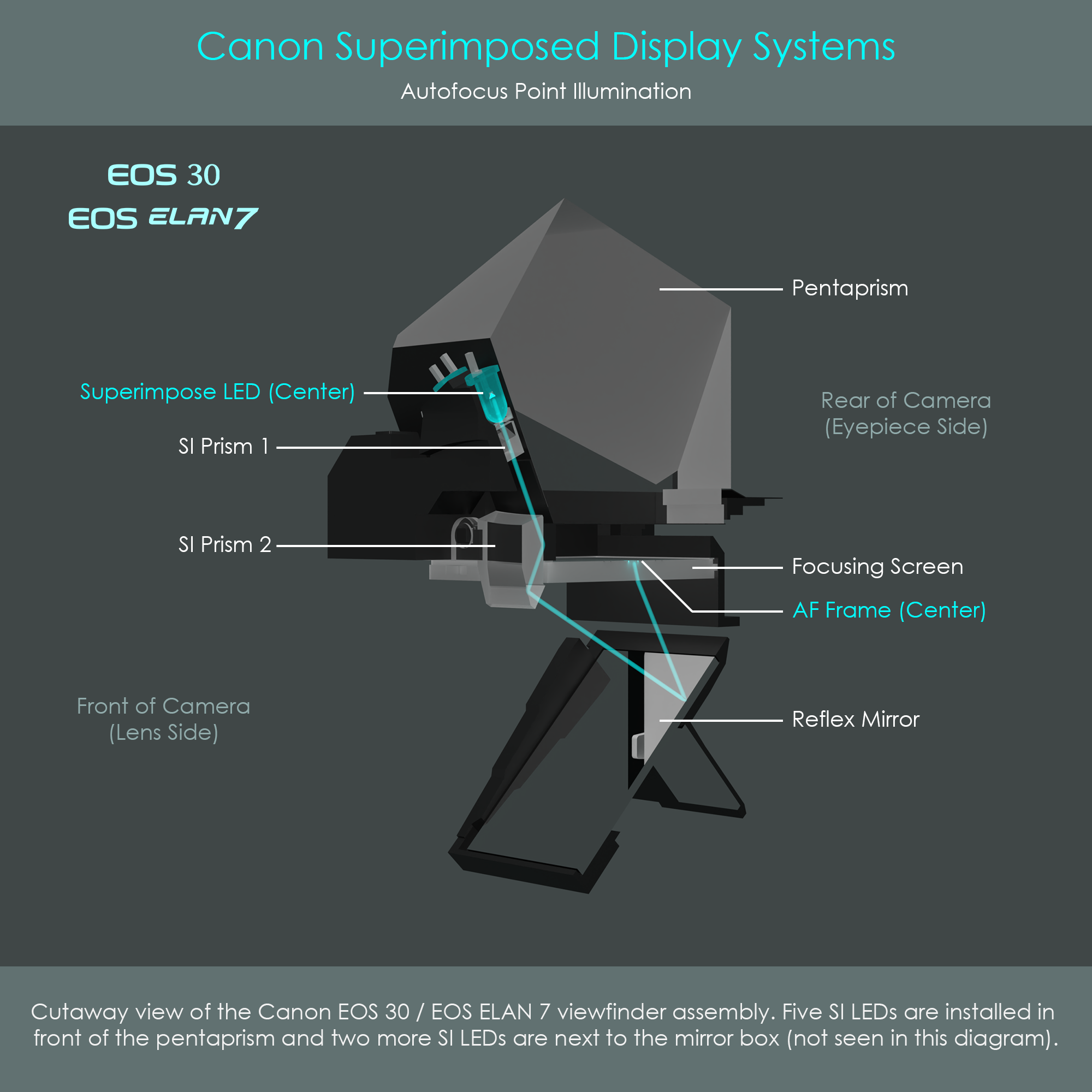
The following illustration is a cutaway diagram of the Canon EOS 30 viewfinder unit. The upper five superimpose LEDs are positioned inside a support structure which is part of the pentaprism seat. Light from these five LEDs passes through SI prisms 1 and 2 before hitting the reflex mirror, and finally lighting up the AF frames on the focusing screen.
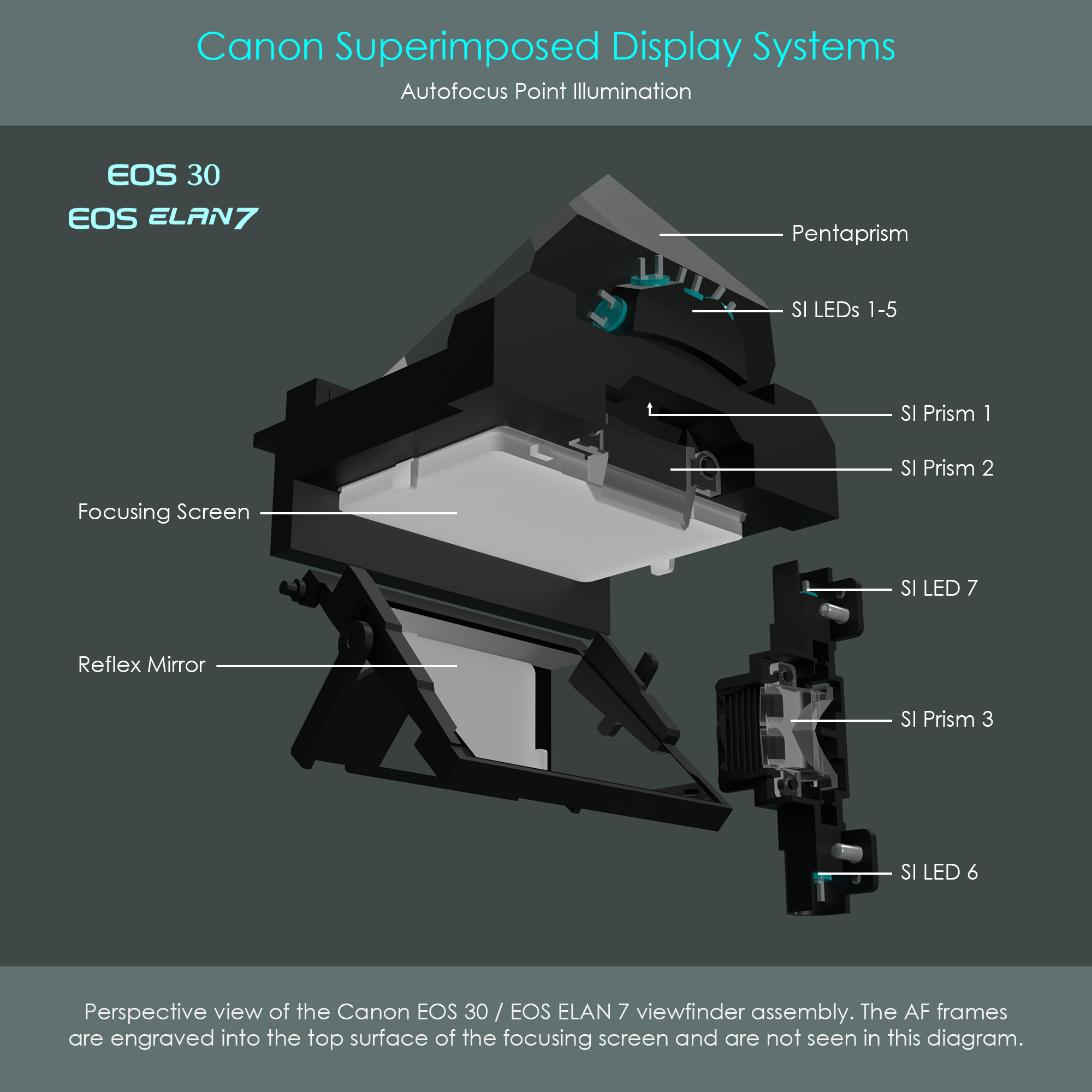
Here is a more complete view of the camera's seven-point AF illumination system. The additional SI LEDs 6 and 7 are positioned inside a dedicated support structure that is screwed to an opening at the side of the reflex mirror box. Light from these SI LEDs 6 and 7 passes through SI prism 3 before hitting the reflex mirror, and finally lighting up the AF frames on the focusing screen.
This next diagram shows the same perspective of the viewfinder unit but with animated beams of light. The animation toggles through all the AF frames.


Here is an identical perspective of the superimposed display system but only optical components are shown. This completely uncovers all the SI prisms and clearly shows the paths of light. The animation toggles through all the AF frames.
Only optical components are shown but from a top perspective. The animation toggles through all the AF frames. This view clarifies how the upper SI LEDs 1-5 illuminate the AF frames that are arranged in a horizontal line while the side LEDs 6-7 illuminate the upper and lower AF frames of the cross configuration. Once an AF frame lights up in red, it can be seen very clearly through the eyepiece.

This last diagram is a close-up view of the upper SI prisms 1 and 2. The geometry of SI prism 1 allows the two LEDs at the outer sides to be placed almost perpendicular to the intended direction of illumination. Their beams of light enter SI prism 1 at the nearest surface and once they reach the second surface they get internally reflected into the desired path.