



The Canon EOS-1N is a 35mm film SLR camera that was released in 1994. The camera's viewfinder is equipped with five AF frames arranged in a horizontal line, and each of them can be lit up individually. The camera's AF point illumination system uses LEDs located above the pentaprism to shoot beams of light into an SI prism from where it gets redirected towards the AF frames engraved in a dedicated SI screen plate.

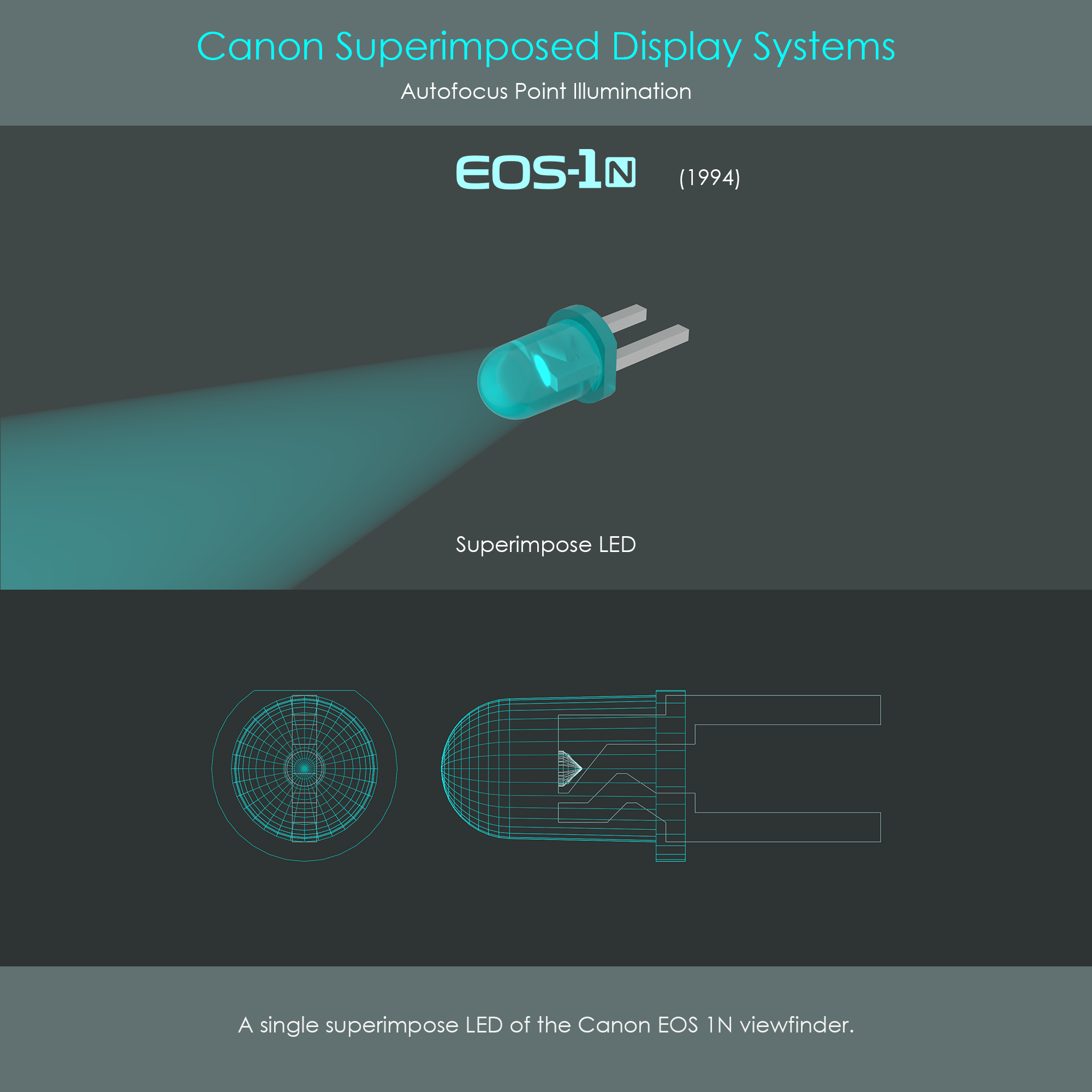
The camera's SI system uses five 3.0 mm LEDs emitting red light. The LED chips are encapsulated in an epoxy package with two parallel connecting pins (cathode and anode), which is a popular format called a dual-in-line package (DIP). The front of the epoxy package is shaped into a small lens to create an intense and directional radiation pattern.
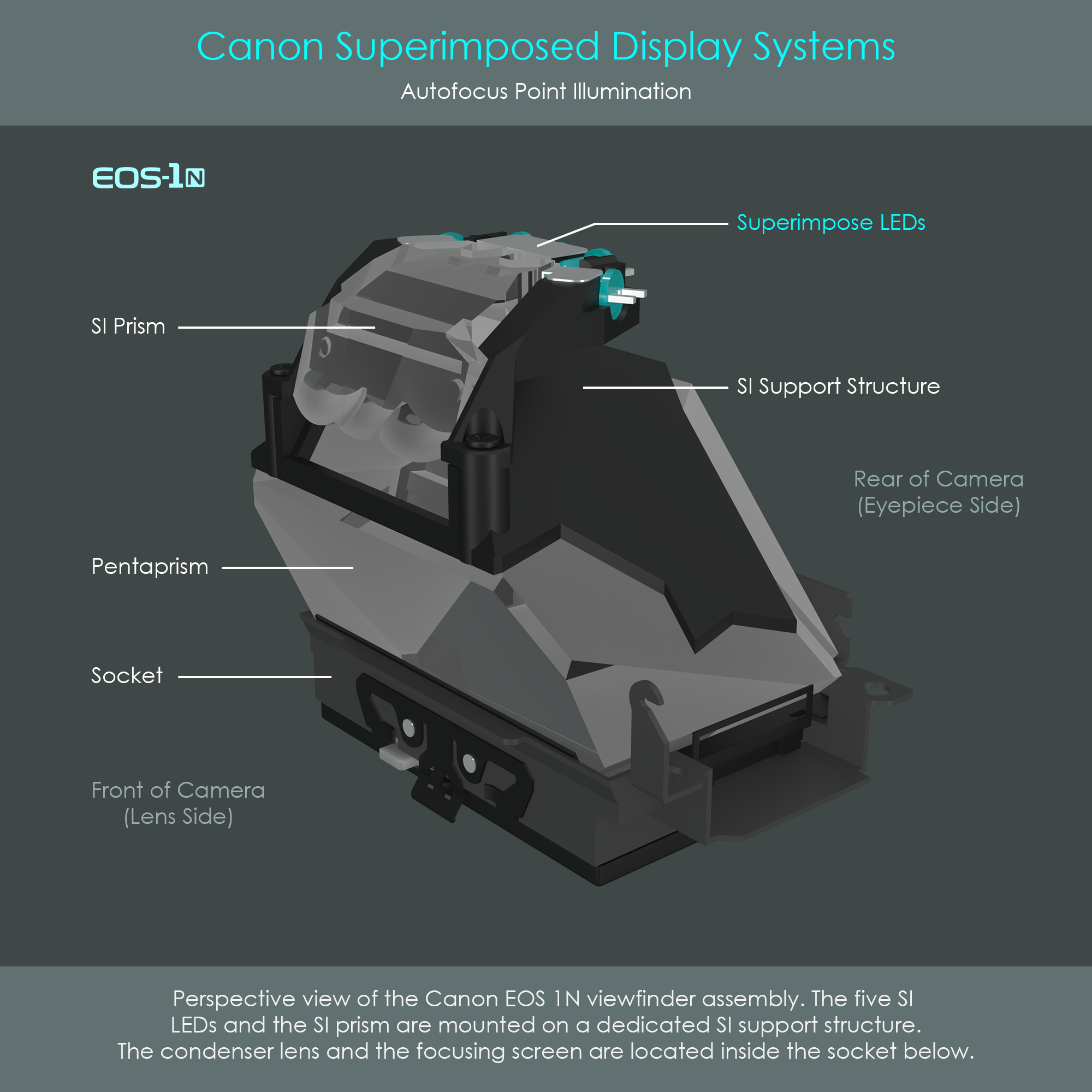
The superimpose LEDs are positioned inside an SI support structure mounted to the top of the pentaprism. The lower part of the SI prism is shaped into three lens surfaces. The pentaprism is held in place by a metal socket which also houses the condenser lens, the SI screen, and the focusing screen (not seen in this diagram).
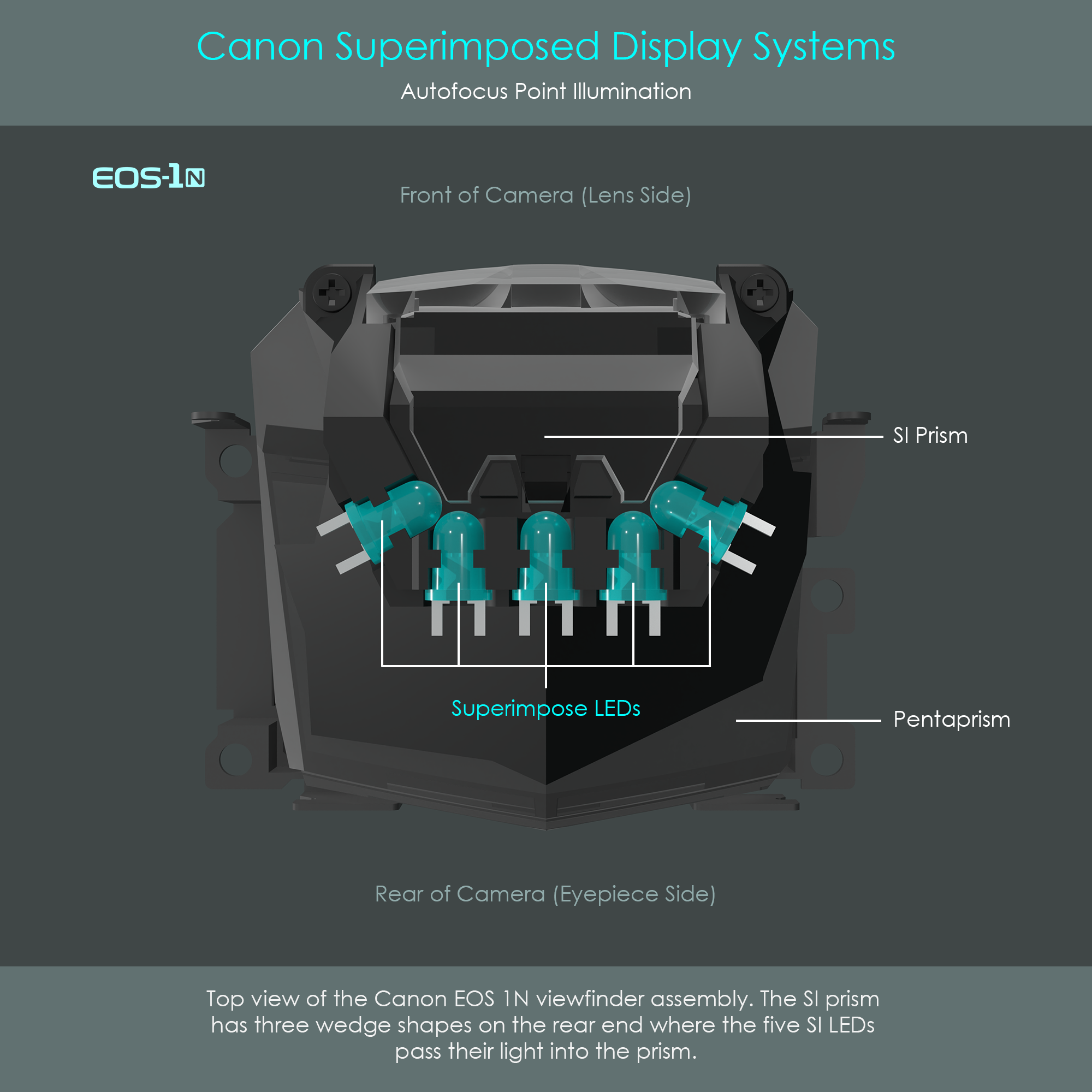
Looking at the viewfinder unit from the top illustrates the arrangement of SI LEDs as well as the geometry of the SI prism. Notice how the two LEDs at the outer sides are placed in a rather counter-intuitive way. However, their beams of light enter the SI prism at the nearest surface and once they reach the second surface they get internally reflected towards the front. This is an ingenious approach to installing the LEDs in a space-saving way and keeping the overall optics compact.
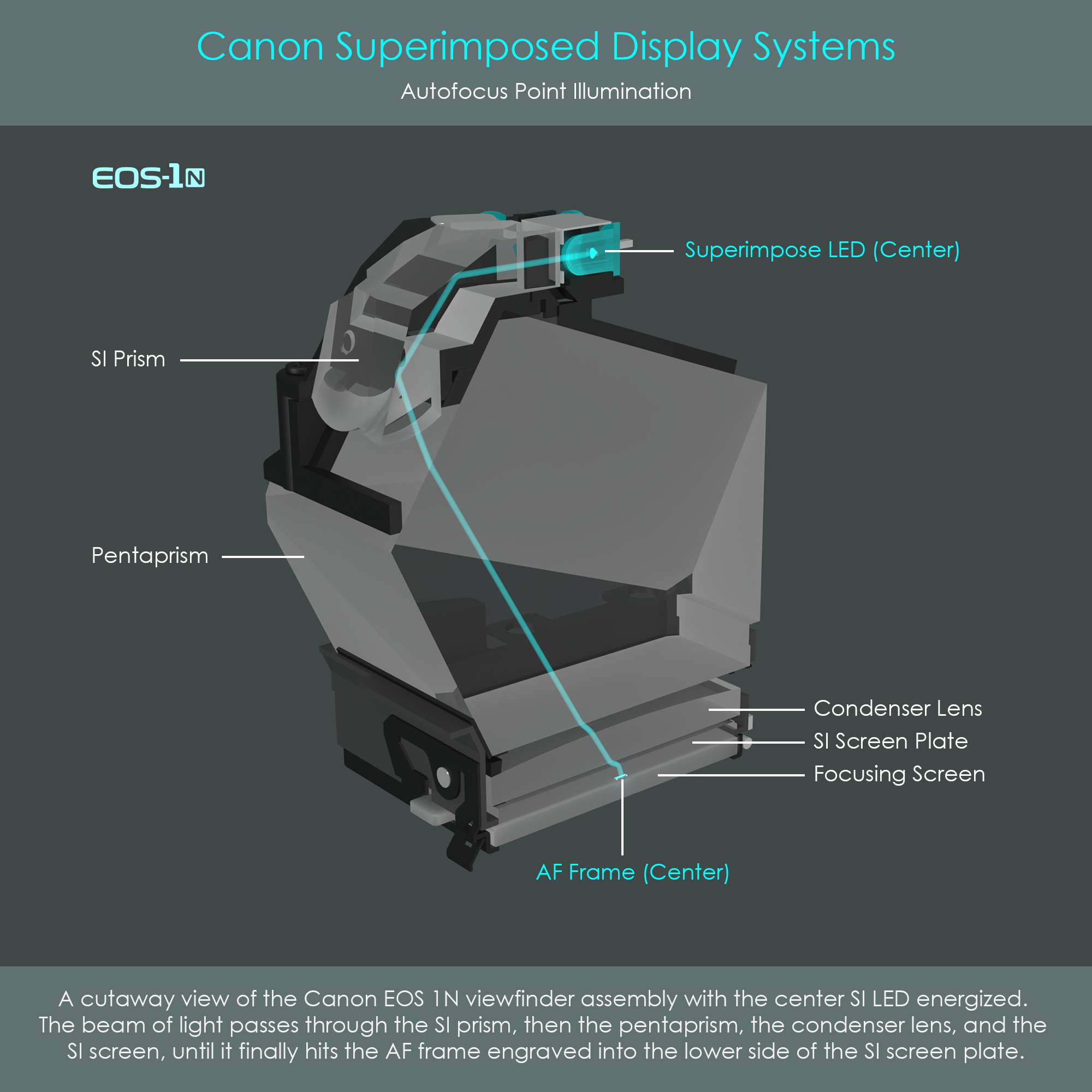
Here is a cutaway diagram of the five-point AF illumination system. Light from each LED (in this diagram it is the center LED) is passed into the SI prism which redirects the beams of light downwards via internal reflections. Light that leaves the SI prism is pointed at the front surface of the pentaprism where it enters the glass. After passing through the pentaprism, light passes through the condenser lens, and finally reaches the SI screen where it illuminates the AF frame. Once an AF frame lights up in red, it can be seen very clearly through the eyepiece.

Here is a front view of the superimposed display system but only optical components are shown. This clarifies which parts are actually involved in the AF point illumination. Note how the paths of light from the two side LEDs is immediately corrected by the internal reflections. The animation toggles through all the AF frames.
Only optical components are shown but from another perspective. The animation toggles through all the AF frames.
