


The Canon EOS D60 is an early APS-C format DSLR camera that was released in March 2002. The camera's viewfinder is equipped with three AF frames arranged in a horizontal line, and each of them can be lit up individually. The camera's AF point illumination system uses LEDs located behind the pentaprism to shoot beams of light into the direction of the reflex mirror. Light reflects off the reflex mirror and is directed towards the individual AF frames engraved into the focusing screen.
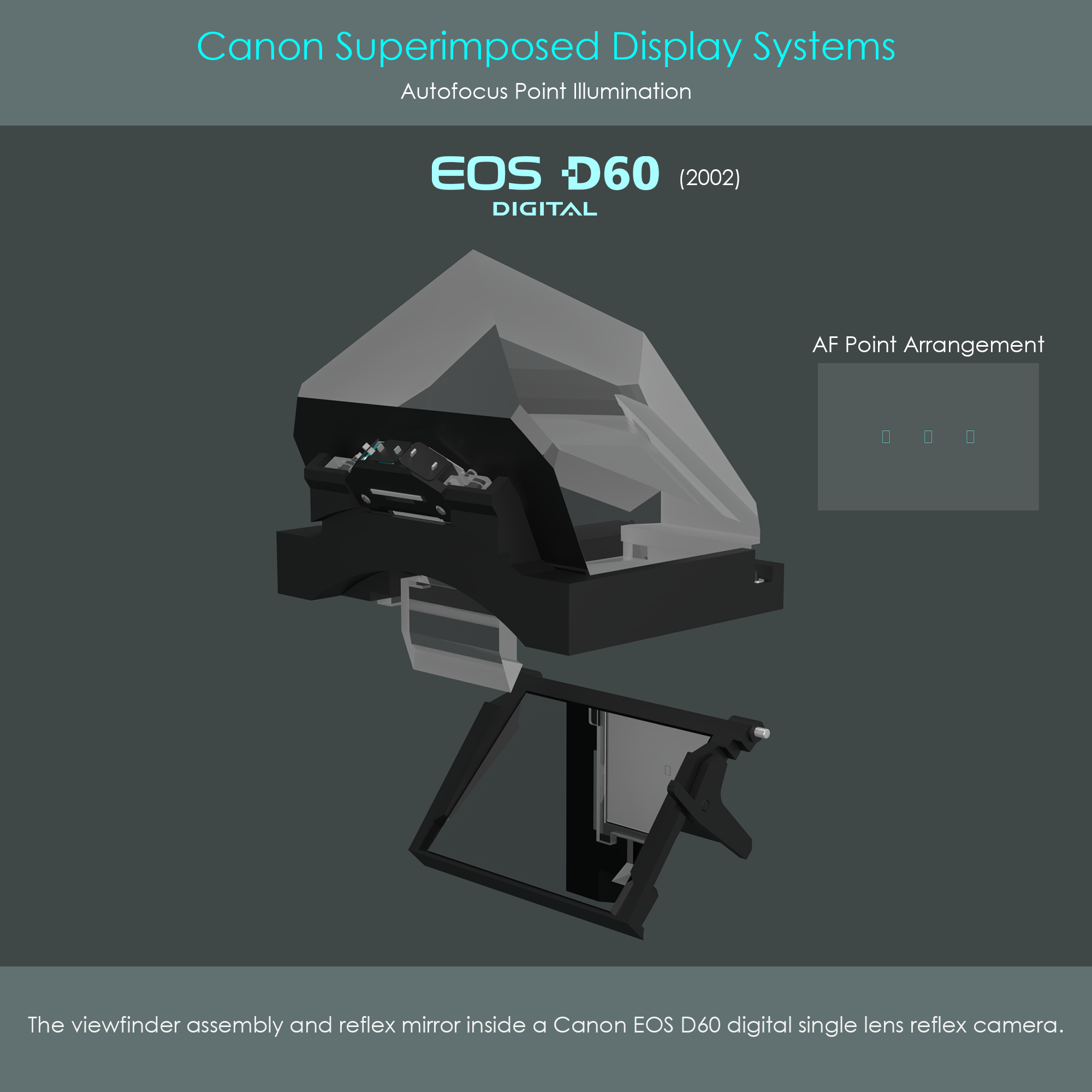

The camera's SI system uses three 1.8 mm LEDs emitting red light. The LED chips are encapsulated in an epoxy package with two axial connecting pins (cathode and anode). The front of the epoxy package is shaped into a tiny lens to create an intense and directional beam of light.
The superimpose LEDs are positioned inside a support structure so that their light is passed into SI prism 1 from which light is then passed into SI prism 2. The SI prisms are designed so that internal reflections may occur but light can enter and leave at certain surfaces. While using the viewfinder, the reflex mirror is in its lower position so light from the SI prism 2 can reflect off into the direction of the focusing screen. The light is a visible flash on the AF frame so it can clearly be seen even if there is a bright preview image on the focusing screen. Light from the focusing screen and the AF frames is then passed through the pentaprism (where it is also flipped into the correct orientation) towards the eyepiece.

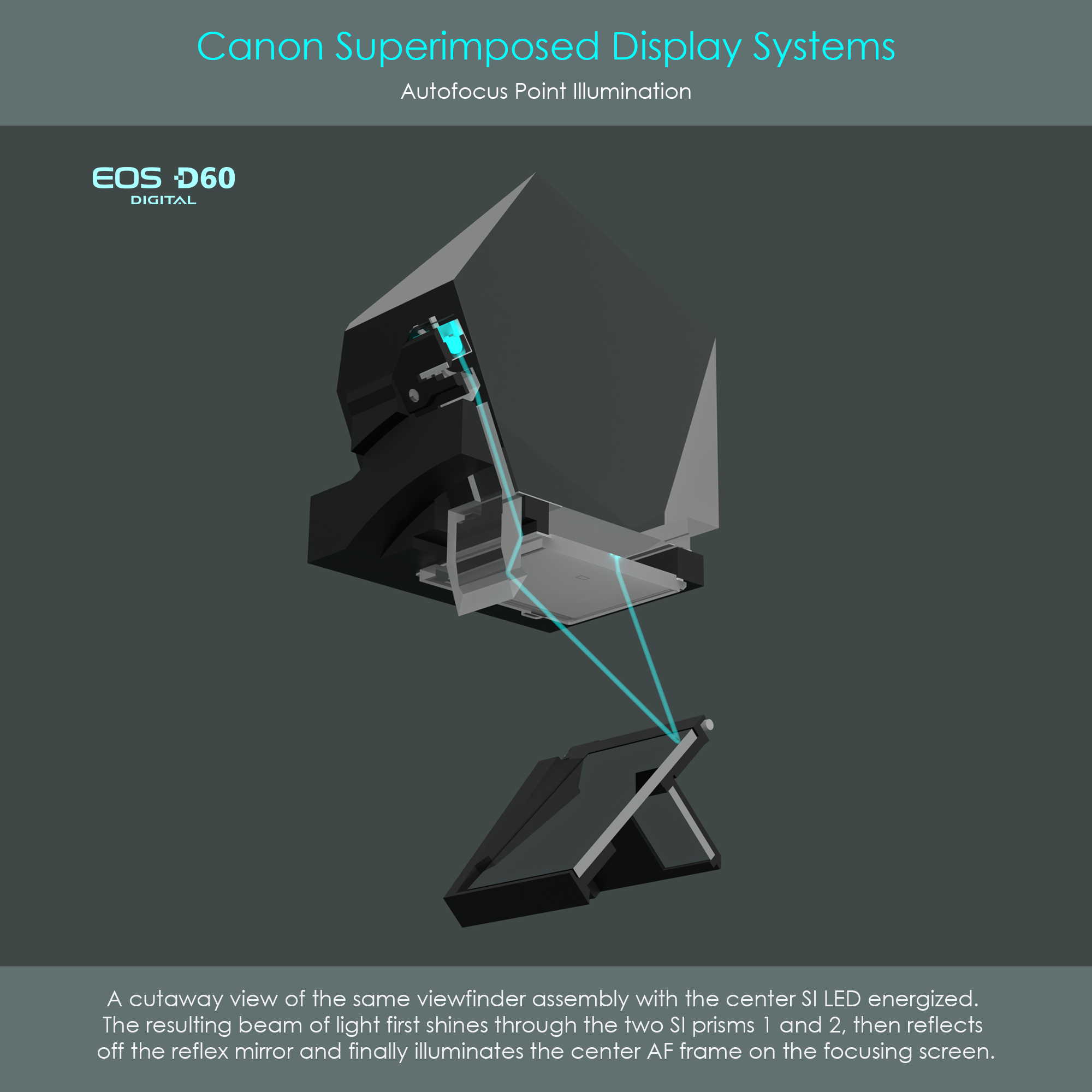
A cutaway view of the same viewfinder assembly can better illustrate the path of light from the SI LEDs through the two SI prisms, onto the reflex mirror and onto the focusing screen where the AF frames are etched into the surface.
Another perspective of the viewfinder but without the pentaprism to better show the AF frames lighting up. The animation toggles through all the AF frames.


Here is the same perspective of the viewfinder as seen before but only optical components are shown. This clarifies which parts are actually involved in the AF point illumination. The animation toggles through all the AF frames.
Only optical components are shown but from another perspective. The animation toggles through all the AF frames.