
An illustrated story about how Canon went from 6-zone metering sensors (1987) to their most advanced 216-zone 400,000-pixel RGB+IR metering systems (2020).






Providing only three metering zones, this is the least complex metering system that Canon has ever used in their EOS SLR cameras. However, it is not their first AE light metering system. Canon had already introduced a 6-zone metering system three years earlier with the launch of the Canon EOS technology. The 3-zone system shown here was introduced in 1990, specifically designed for Canon's 1000-series of entry-level cameras. The reduction in complexity was very likely for reasons of cost efficiency.
The central metering zone 1 is identical in size as the partial metering circle that is engraved into the camera's focusing screen. Zone 1 is surrounded by metering zone 2, and zone 3 covers the remaining viewfinder image. These metering zones are invisible to the user.
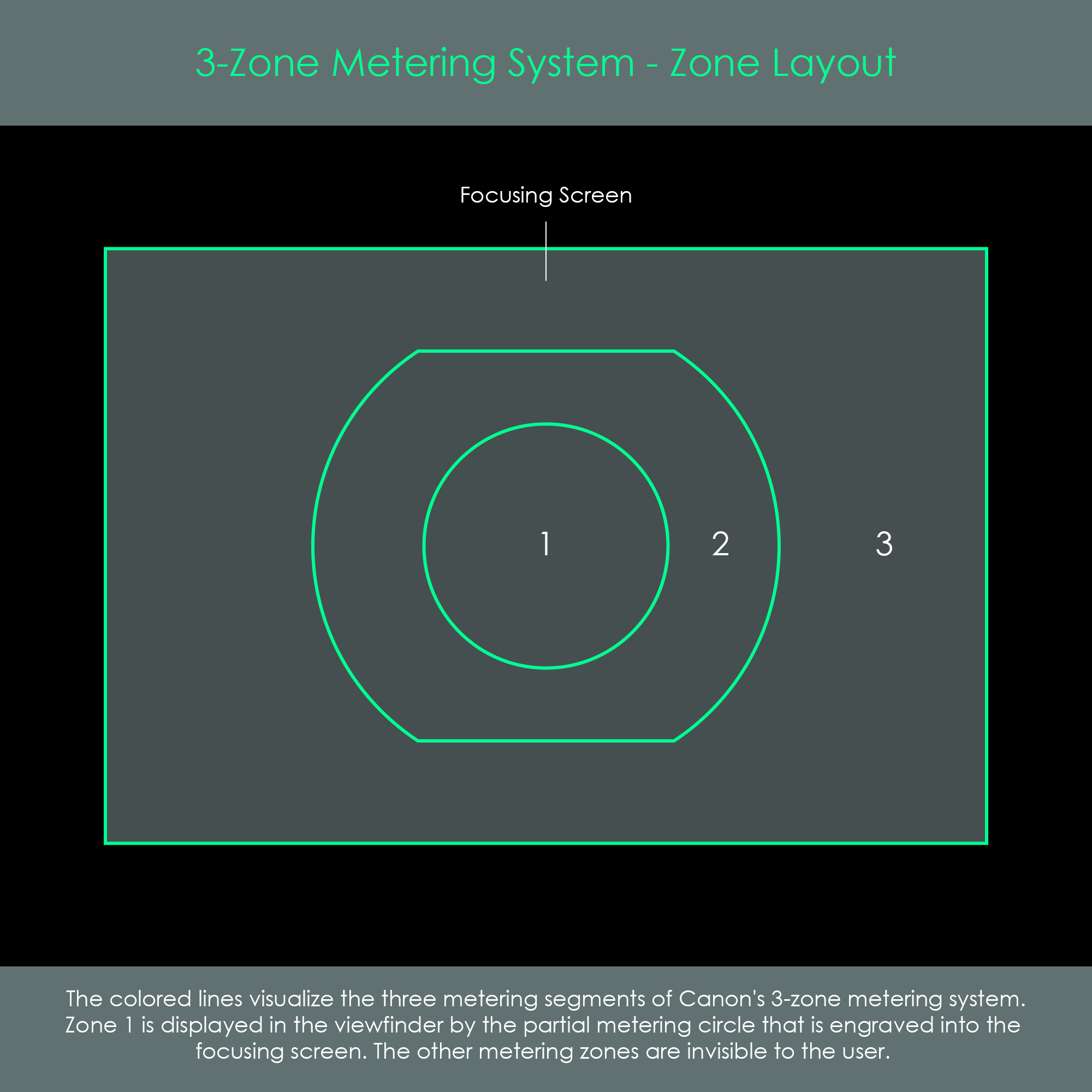
This 3-zone metering sensor allows the camera electronics to offer the following metering modes to the user: 3-zone evaluative metering, partial metering (zone 1) which covers approximately 9% of the central picture area, and center-weighted average metering.
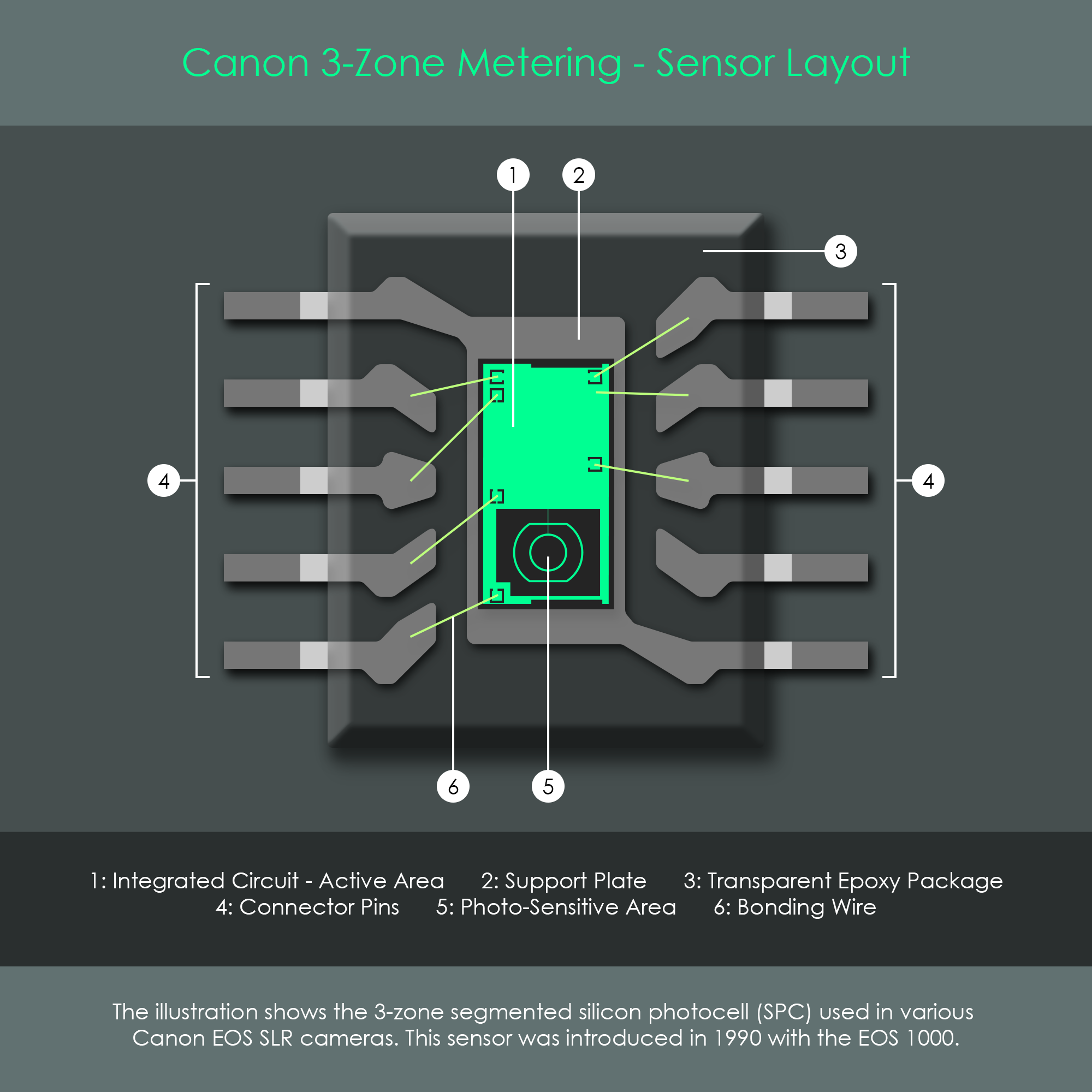
The sensor consists of support structures, connector pins, and the integrated circuit (IC) die embedded inside a clear-molded package. This sensor uses a 3-zone segmented SPC (silicon photocell) as the actual light-sensitive part. Some of the IC's active area surrounding the SPC is used for signal amplification and processing. The amplification circuitry allows the camera to use auto-exposure metering even in low-light situations.
EV 2 - 20 at ISO 100.