
An illustrated story about how Canon went from 6-zone metering sensors (1987) to their most advanced 216-zone 400,000-pixel RGB+IR metering systems (2020).






This 1st-generation 6-zone evaluative metering system was the first multi-zone AE system ever used on Canon's EOS platform of SLR cameras. Cameras prior to EOS had only used very basic photocells measuring just one average light intensity across the entire focusing screen. This 6-zone segmentation made a new type of light analysis possible for the first time — evaluative metering. This innovative technology was designed to minimize extreme over- or underexposures by analyzing the different parts of an image separately. This ensures that the measurement system takes into account particularly bright or particularly dark areas, rather than blending all brightness levels into an average value. Canon called this their Factor-Six Light Analysis System. It marked the beginning of a fascinating 30-year evolution that would eventually lead to infrared-measuring, facial-recognition, and deep learning-based measurement systems.
The central metering zone 1 is identical in size as the partial metering circle that is engraved into the camera's focusing screen. Zone 1 is surrounded by metering zone 2, and the remaining viewfinder image is divided into four more zones (3-6). These metering zones are invisible to the user.
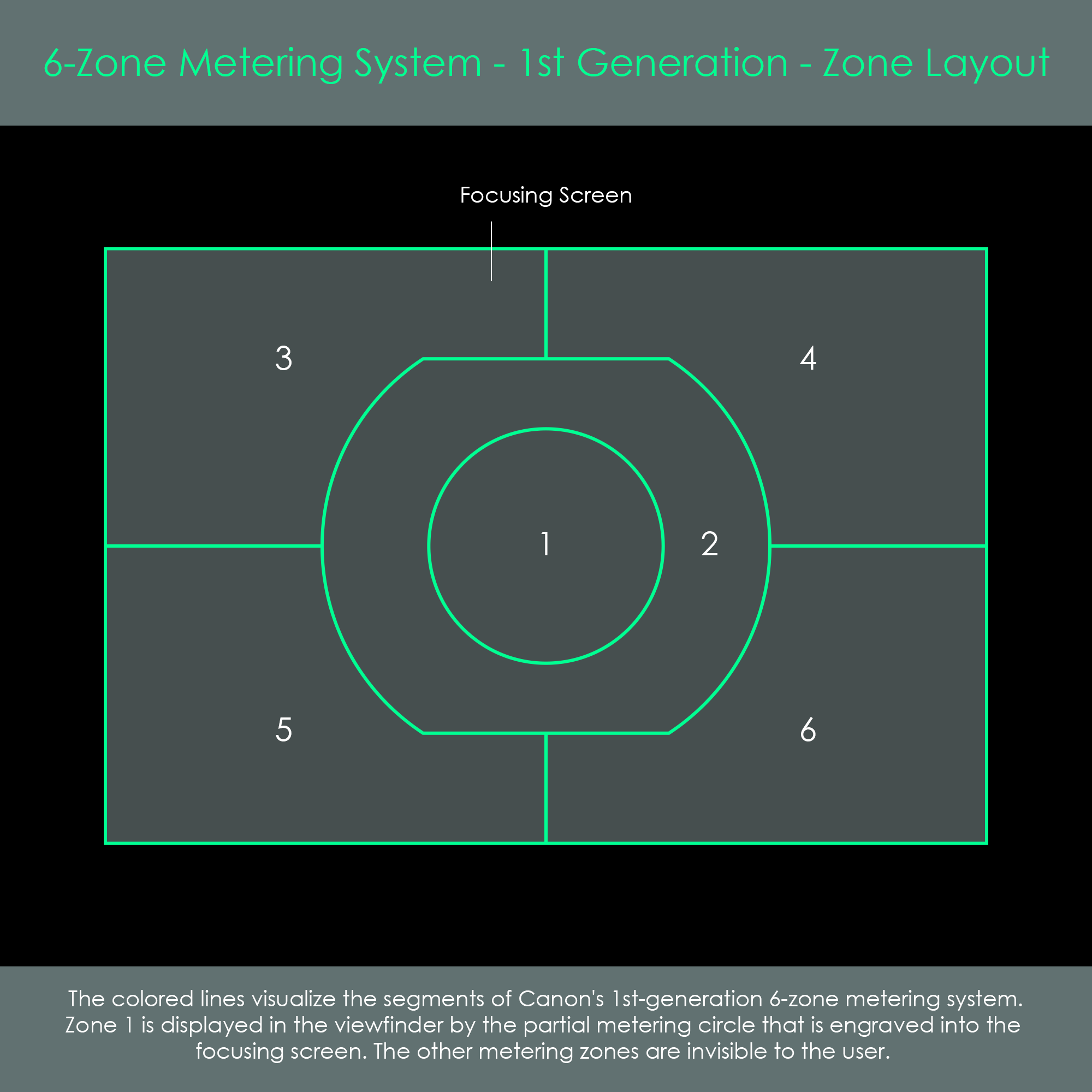
This 1st-generation 6-zone metering offers the following metering modes: 6-zone evaluative metering and partial metering (zone 1) which covers approximately 7% of the central picture area.
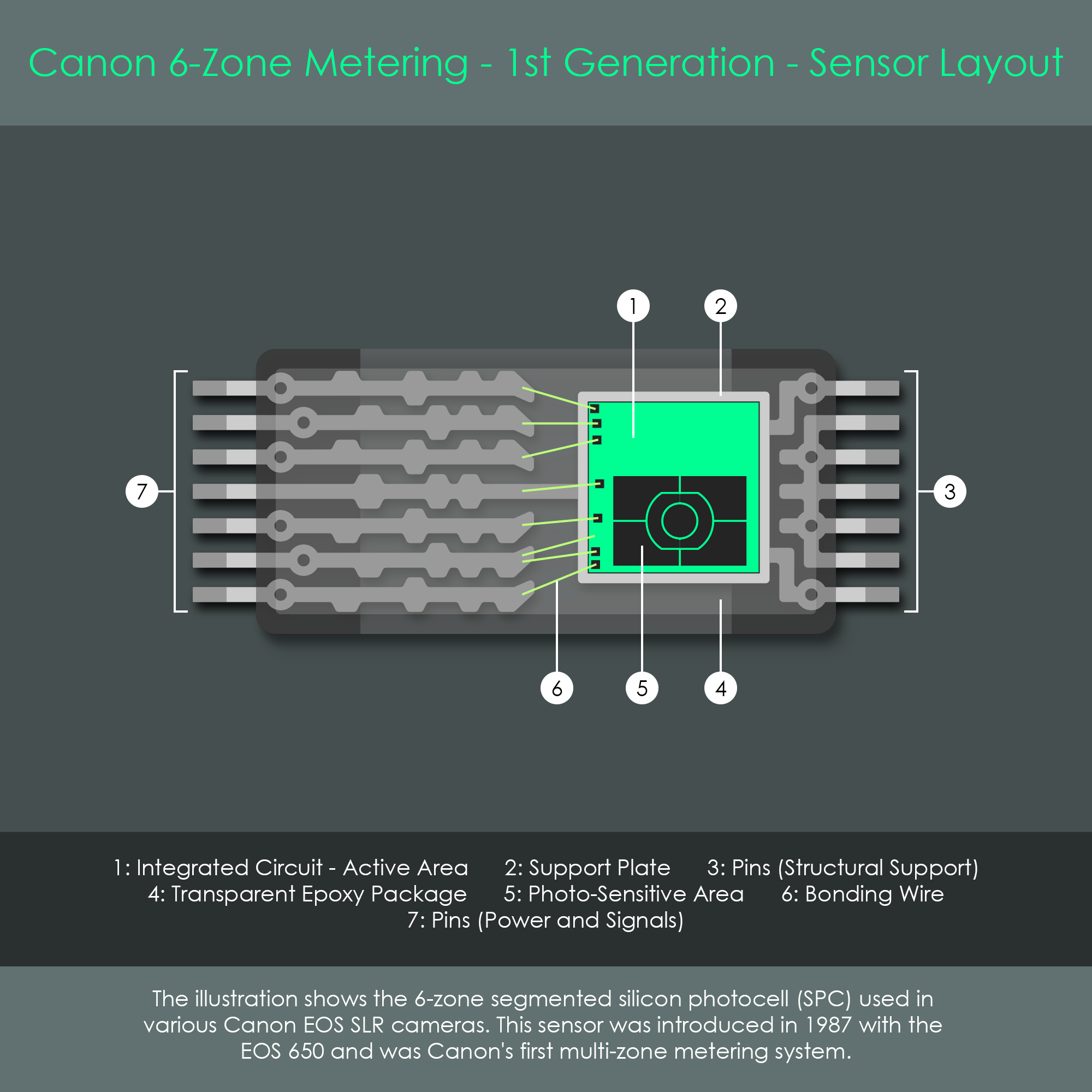
The sensor consists of support structures, connector pins, and the integrated circuit (IC) die embedded inside a clear-molded package. This sensor uses a 6-zone segmented SPC (silicon photocell) as the actual light-sensitive element. Some of the IC's active area surrounding the SPC is used for signal amplification and processing. The amplification circuitry allows the camera to use auto-exposure metering even in low-light situations. The metal pins on the right are not used for electrical contact but to securely attach the sensor with the circuit board.
EV 1 - 20 at ISO 100.
Introduced in 1993, this is the 2nd-generation of 6-zone evaluative metering systems. Although still providing six light metering zones, this successor system was designed specifically for EOS cameras offering three autofocus points.
This metering system uses a different zone layout to provide optimal coverage of the cameras' autofocus (AF) points. Zones 1-3 cover the three AF points, zones 4 and 5 offer light metering in the area directly surrounding the AF points (intermediate area), and zone 6 covers the remaining viewfinder image (peripheral area). These metering zones are invisible to the user.
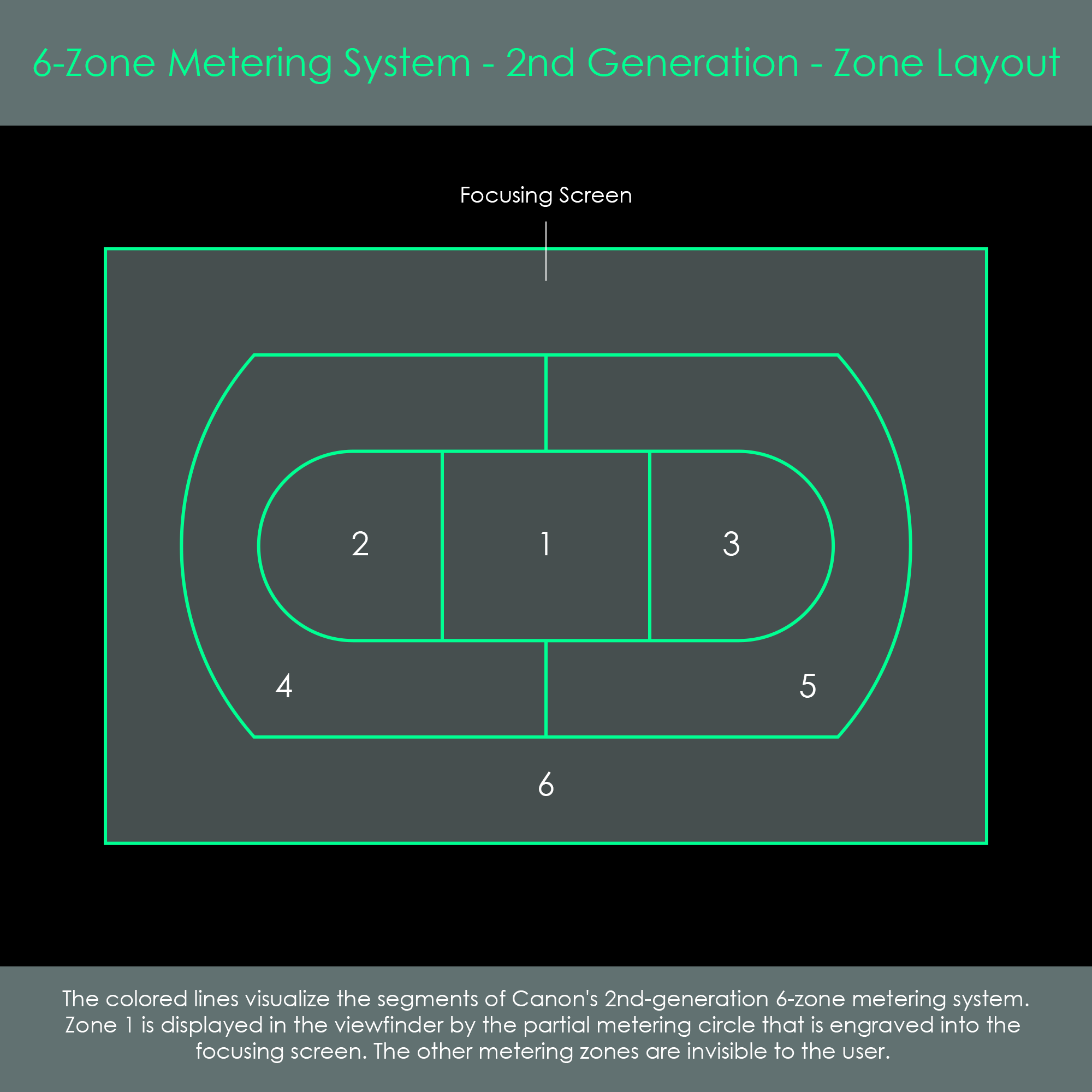
This 2nd-generation 6-zone metering offers the following metering modes: 6-zone evaluative metering, partial metering (zone 1) which covers approximately 9% of the central picture area, and center-weighted average metering.
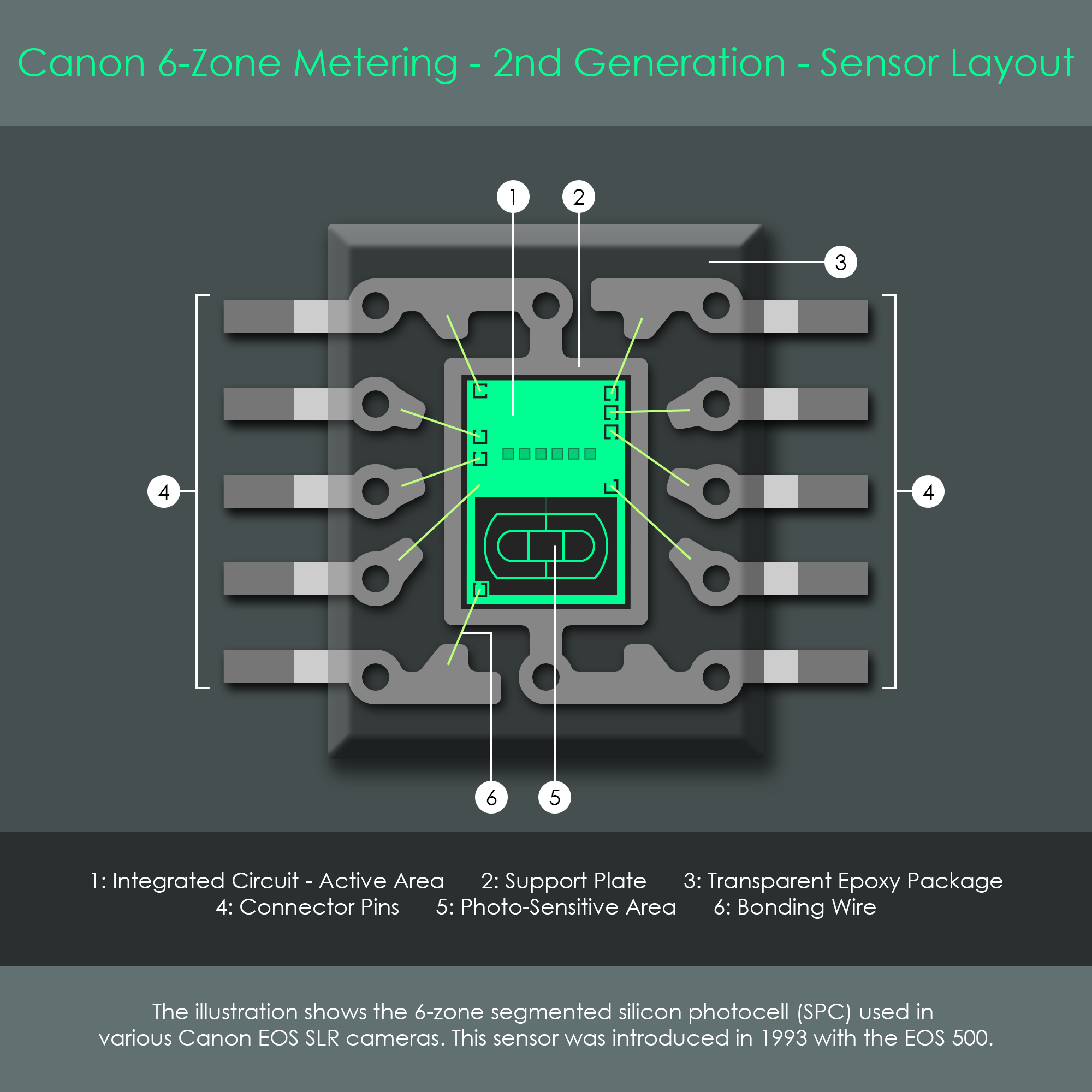
The overall sensor design is very similar to the previous one, and support structures, connector pins, as well as the integrated circuit (IC) die are embedded inside a clear-molded package. However, this 2nd-generation 6-zone sensor uses a more compact design for its package. This sensor uses a 6-zone segmented SPC (silicon photocell) as the actual light-sensitive element. Some of the IC's active area surrounding the SPC is used for signal amplification and processing. The amplification circuitry allows the camera to use auto-exposure metering even in low-light situations, though not quite as low as with the 1st-generation chip.
EV 2 - 20 at ISO 100.