
An illustrated story about how Canon went from 6-zone metering sensors (1987) to their most advanced 216-zone 400,000-pixel RGB+IR metering systems (2020).






While the 35-zone metering system didn't really introduce a new technology, the number of metering zones was increased quite noticeably. The actual innovation to mention here is that this metering system was the first that arranged its light-sensitive zones in a uniform grid.
The metering zones are arranged in a grid of 7 columns and 5 rows, resulting in 35 metering zones of equal size. These metering zones are invisible to the user.
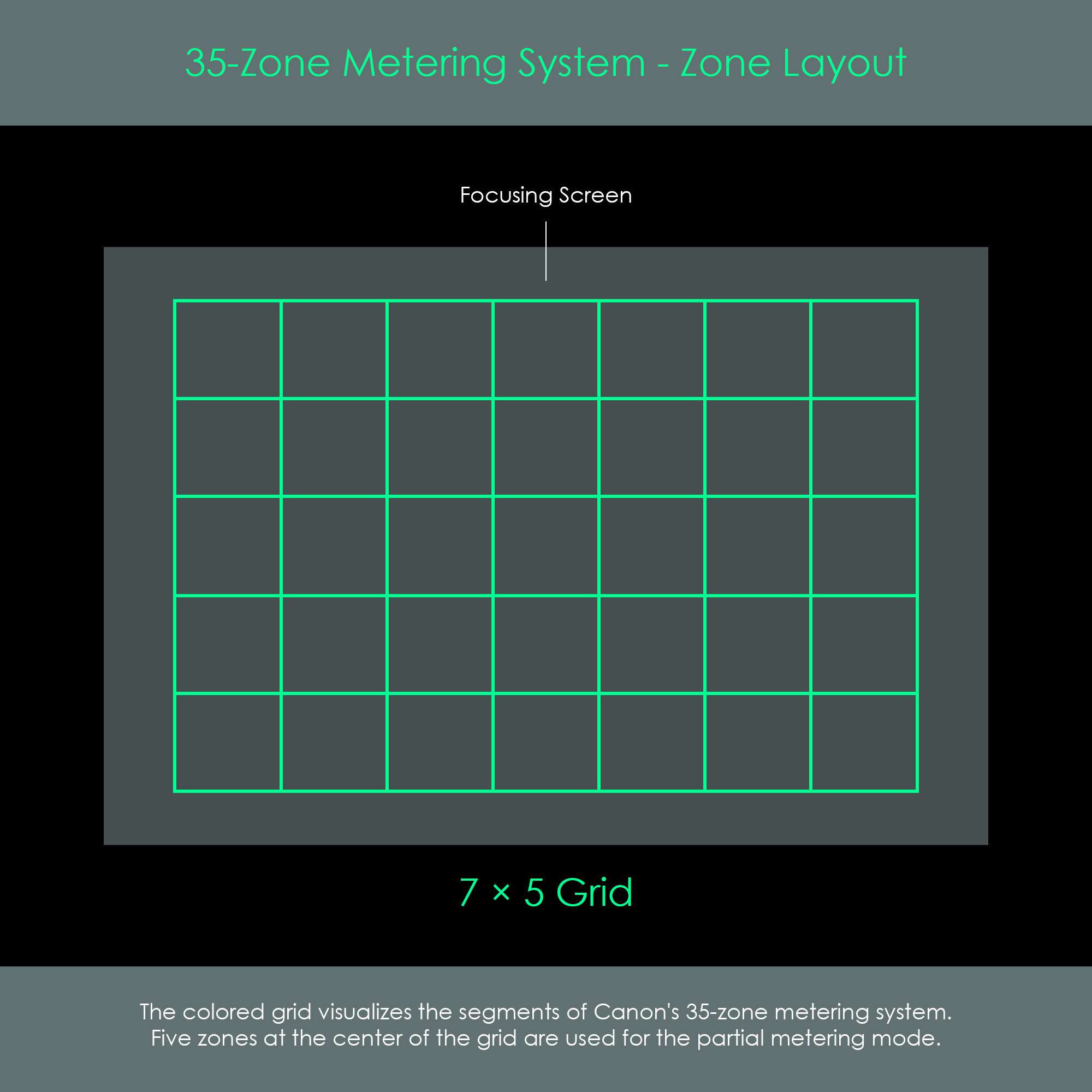
This system offers the following metering modes: 35-zone evaluative metering, partial metering (five zones covering approximately 9% of the central picture area in a cross shape), and center-weighted average metering. Spot metering is available only on some of the camera models listed above (EOS 5D, EOS 5D Mark II, for example).
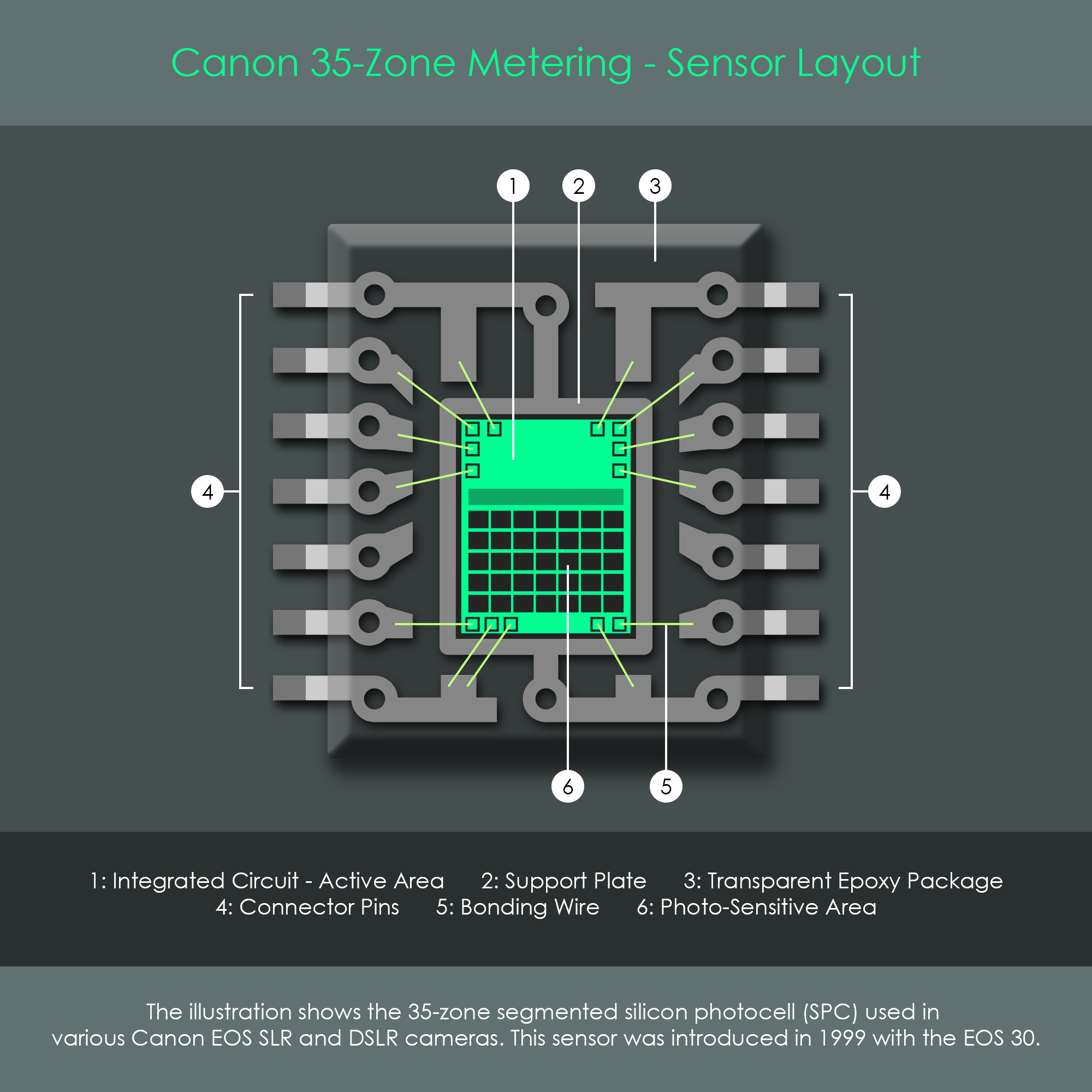
The sensor consists of support structures, connector pins, and the integrated circuit (IC) die embedded inside a clear-molded package. This sensor uses a 35-zone segmented SPC (silicon photocell) as the actual light-sensitive part. Some of the IC's active area surrounding the SPC is used for signal amplification and processing. The amplification circuitry allows the camera to use auto-exposure metering even in low-light situations.
EV 1 - 20 at ISO 100.