
An illustrated story about how Canon went from 6-zone metering sensors (1987) to their most advanced 216-zone 400,000-pixel RGB+IR metering systems (2020).













This advanced metering system is utilizing a high-resolution 220,000-pixel RGB+IR photodetector array. Cameras using this metering system integrate Canon's iSA (Intelligent Subject Analysis) and iTR (Intelligent Tracking and Recognition) AF systems, technologies first introduced in 2012 with the EOS-1D X. While the iSA system evaluates the scene via a high-resolution metering sensor, the iTR AF system processes this data to maintain continuous focus on moving subjects across the 45 cross-type AF points. Read more about iSA and iTR here.
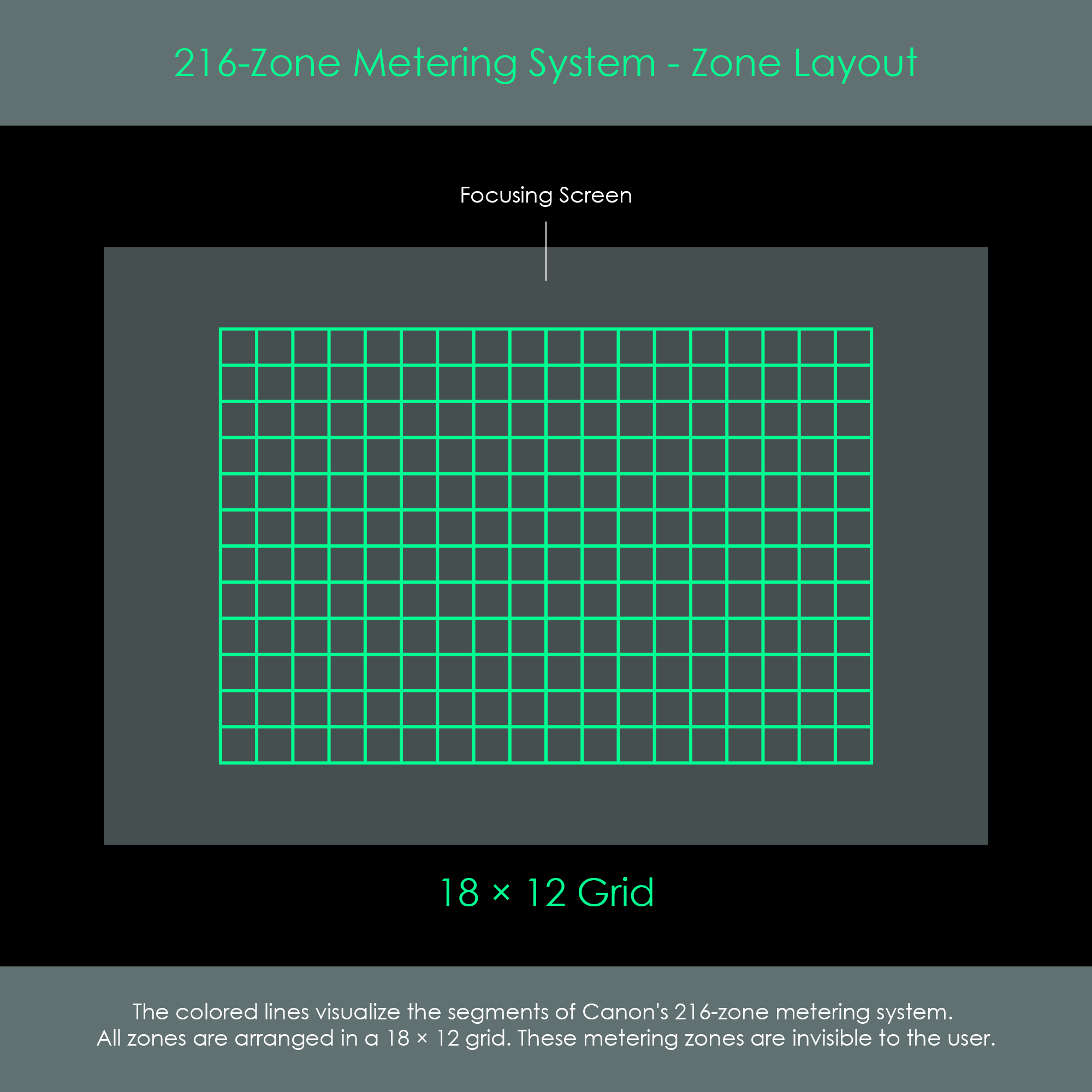
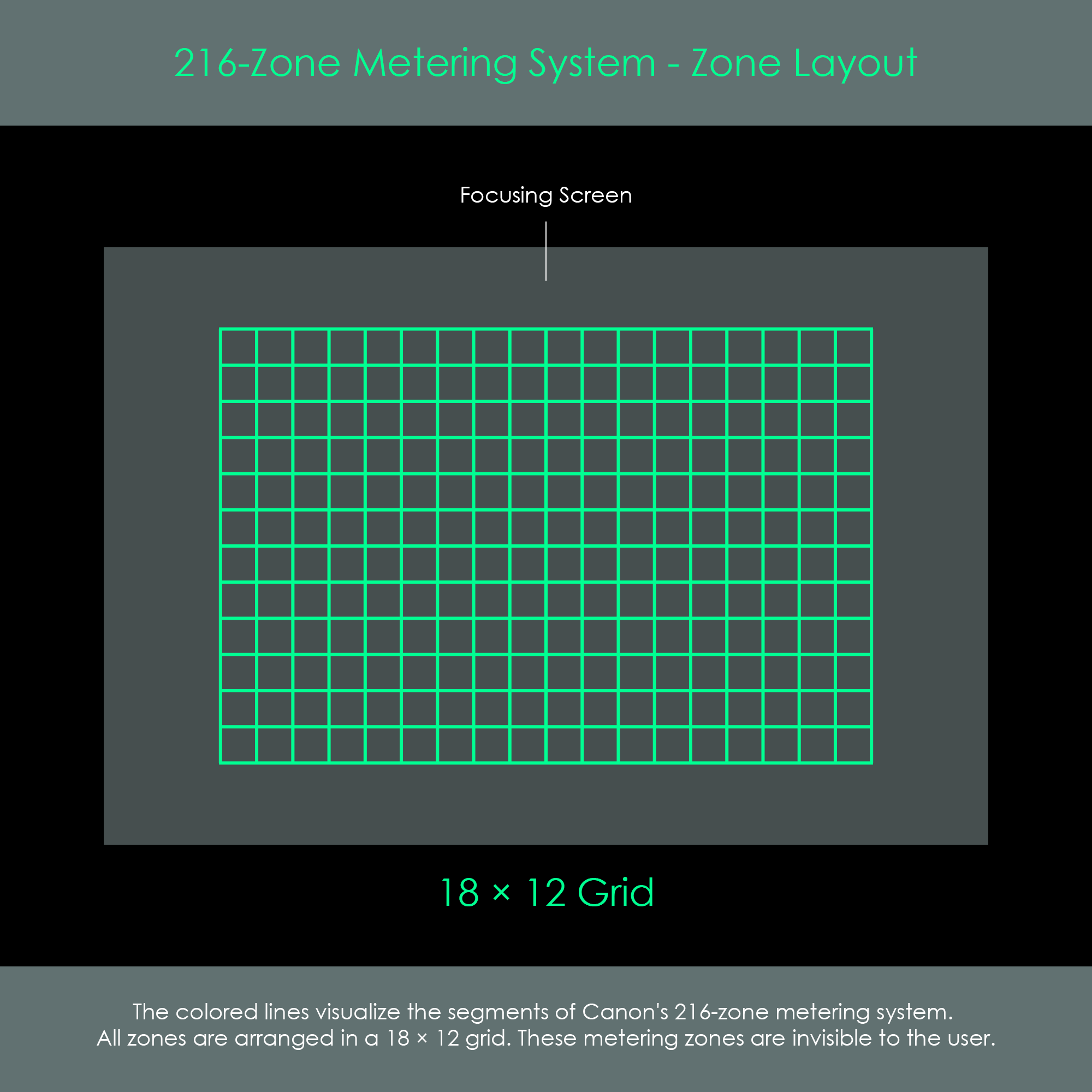
This metering system uses a grid of 18 columns and 12 rows, resulting in 216 metering zones of equal size. These metering zones are invisible to the user.
Despite an exhaustive review of available literature and documentation, no schematic or visual representation of the metering sensor could be located.
EV 1 - 20 at ISO 100.
This advanced metering system is utilizing a high-resolution 360,000-pixel RGB+IR photodetector array. Cameras using this metering system integrate Canon's iSA (intelligent Subject Analysis) and iTR (intelligent Tracking and Recognition) AF systems, technologies first introduced in 2012 with the EOS-1D X. While the iSA system evaluates the scene via a high-resolution metering sensor, the iTR AF system processes this data to maintain continuous focus on moving subjects across the 61 AF points. Read more about iSA and iTR here.
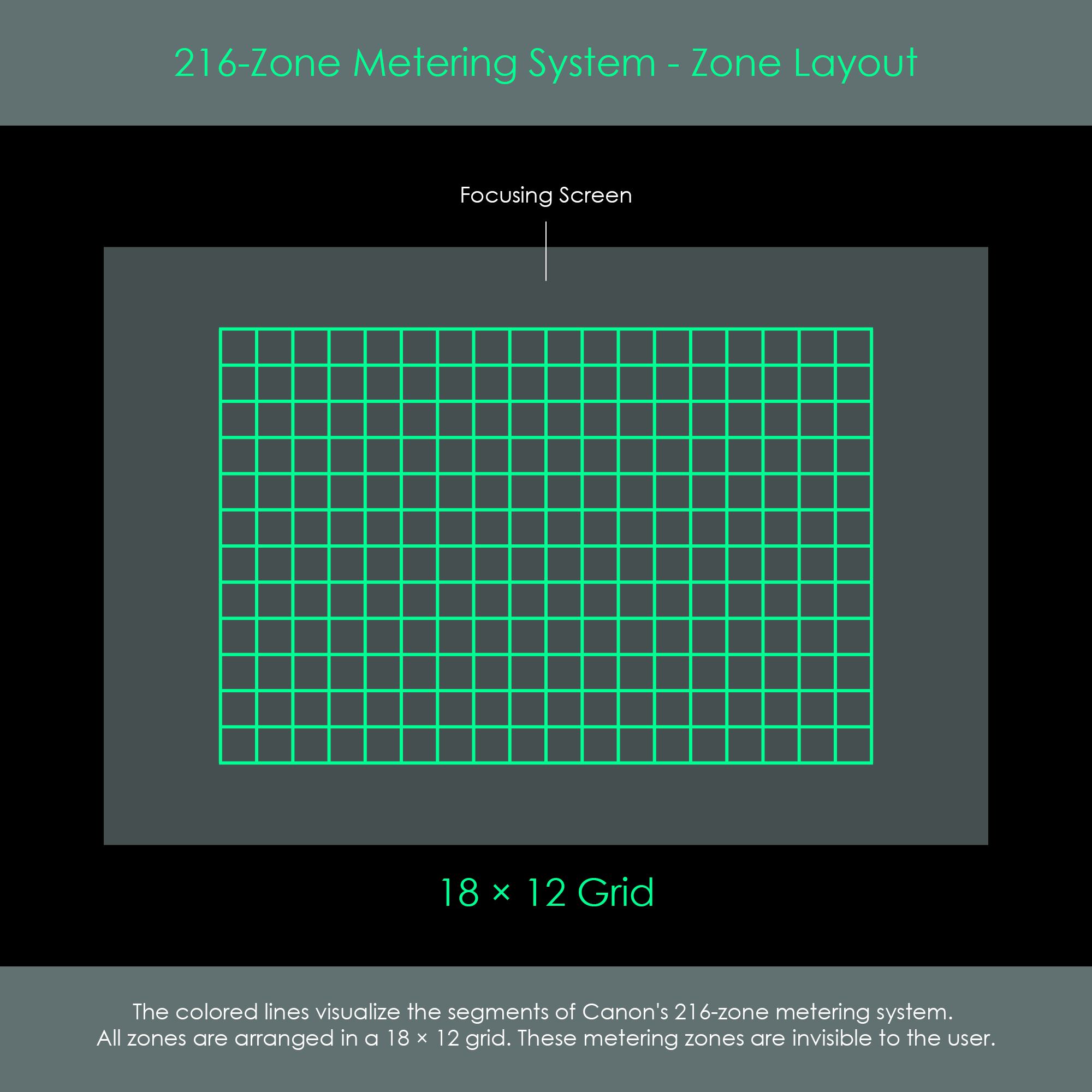
This metering system uses a grid of 18 columns and 12 rows, resulting in 216 metering zones of equal size. These metering zones are invisible to the user.
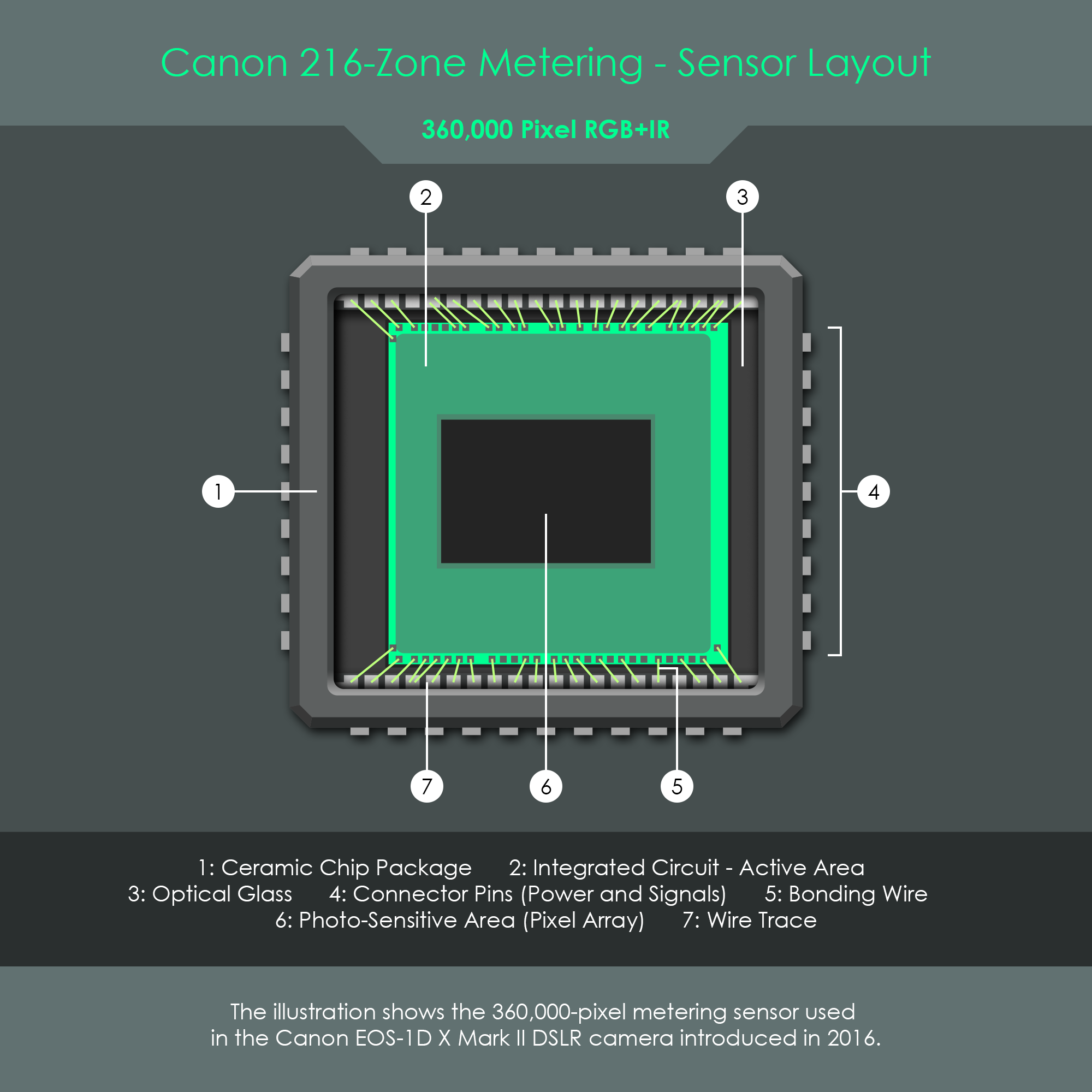
The sensor chip is placed inside a ceramic package with a protective glass cover applied on top. The integrated circuit's active area consists of an array of approximately 360,000 CMOS pixels capable of detecting the full spectrum of visible light as well as near-infrared (NIR) light. The RGB+IR technology typically uses a color filter mask that is applied to a monochrome sensor. In the case of conventional RGB sensors, four pixels always form a cluster, with one red filter, one blue filter, and two green filters placed in front of each photosite (pixel). With RGB+IR sensors, one of the two green pixels is usually replaced with an infrared (IR) pixel. This IR pixel contains red, green and blue filter materials, effectively absorbing all of the light in the visible spectrum. IR light with longer wavelengths will pass through this filter with minimal loss. This effectively creates 25% of all pixels with sensitivity to IR light. The semiconductor material surrounding the light-sensitive pixel array contains amplification and image-processing circuitry.
EV 0 - 20 at ISO 100.
The EOS-1D X Mark III is Canon's ultimate flagship DSLR, engineered specifically for professional sports, action, press, and wildlife photographers. It represents the absolute pinnacle of digital single-lens reflex technology, combining unmatched durability with top-tier speed right before the industry's shift toward mirrorless systems.
The EOS-1D X Mark III is not just an updated version of its predecessor, but instead all aspects of the camera's hardware, processing, and software have been completely redeveloped. Some of the newly engineered systems include a 191-point autofocus system, a new CMOS sensor, a new digital image processor DIGIC X, and a sophisticated metering system utilizing Canon's most advanced 400,000-pixel RGB+IR metering chip ever used on an EOS DSLR camera. A dedicated DIGIC 8 processor is used separately to handle the metering system's data output, and to run subject analysis (iSA) and subject tracking (iTR AF X) programs. Since the metering system also incorporates infrared pixels, the EOS-1D X Mark III offers skin tone detection and light source analysis. Read more about iSA and iTR here. The combined processing power of the DIGIC X and the DIGIC 8 CPUs allowed Canon to introduce an improved Head Detection AF system, supported by deep-learning, which replaces the earlier Face Detection AF algorithm.
This metering system uses a grid of 18 columns and 12 rows, resulting in 216 metering zones of equal size. These metering zones are invisible to the user.
Introduced with the Canon EOS-1D X Mark III, the "X" signifies the integration of deep-learning artificial intelligence. The previous Face Detect AF offers reliable performance only when people are looking at the camera. The new Head Detection AF is able to recognize human heads even when the subject's eyes are covered, turned away, or obscured by obstructions like sunglasses or helmets. This is supported by deep-learning technology where the algorithm has been trained by analyzing thousands of images of heads in varying types of positions, including turned away from the camera, and even wearing various types of sports helmets. Head Detect AF is a powerful new technology, further enhancing the EOS-1D X Mark III's AF performance in situations where the photographer is comfortable relying on using a broad AF Area, and letting the camera automatically maintain focus points upon an erratically moving human subject.
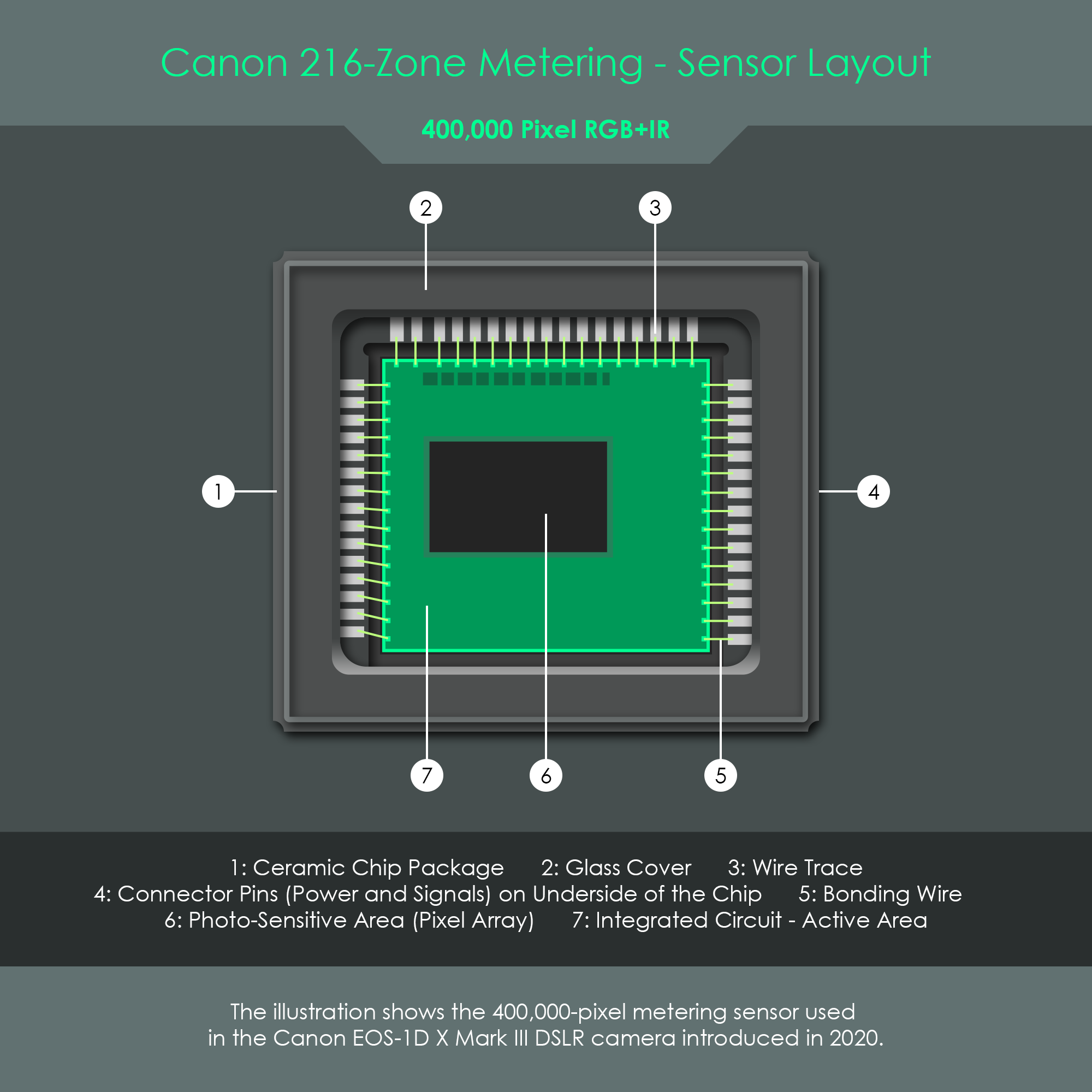
The sensor chip is placed inside a ceramic package with a protective glass cover applied on top. The integrated circuit's active area consists of an array of approximately 400,000 CMOS pixels capable of detecting the full spectrum of visible light as well as near-infrared (NIR) light. The RGB+IR technology typically uses a color filter mask that is applied to a monochrome sensor. In the case of conventional RGB sensors, four pixels always form a cluster, with one red filter, one blue filter, and two green filters placed in front of each photosite (pixel). With RGB+IR sensors, one of the two green pixels is usually replaced with an infrared (IR) pixel. This IR pixel contains red, green and blue filter materials, effectively absorbing all of the light in the visible spectrum. IR light with longer wavelengths will pass through this filter with minimal loss. This effectively creates 25% of all pixels with sensitivity to IR light. The semiconductor material surrounding the light-sensitive pixel array contains amplification and image-processing circuitry.
EV 0 - 20 at ISO 100.