
An illustrated story about how Canon went from 6-zone metering sensors (1987) to their most advanced 216-zone 400,000-pixel RGB+IR metering systems (2020).












The Canon EOS-1D X is a flagship DSLR camera that held the title of the most advanced DSLR of its era. When it was launched in 2012, the camera offered a wide range of genuine innovations:
This metering system uses a grid of 21 columns and 12 rows, resulting in 252 metering zones of equal size. These metering zones are invisible to the user.
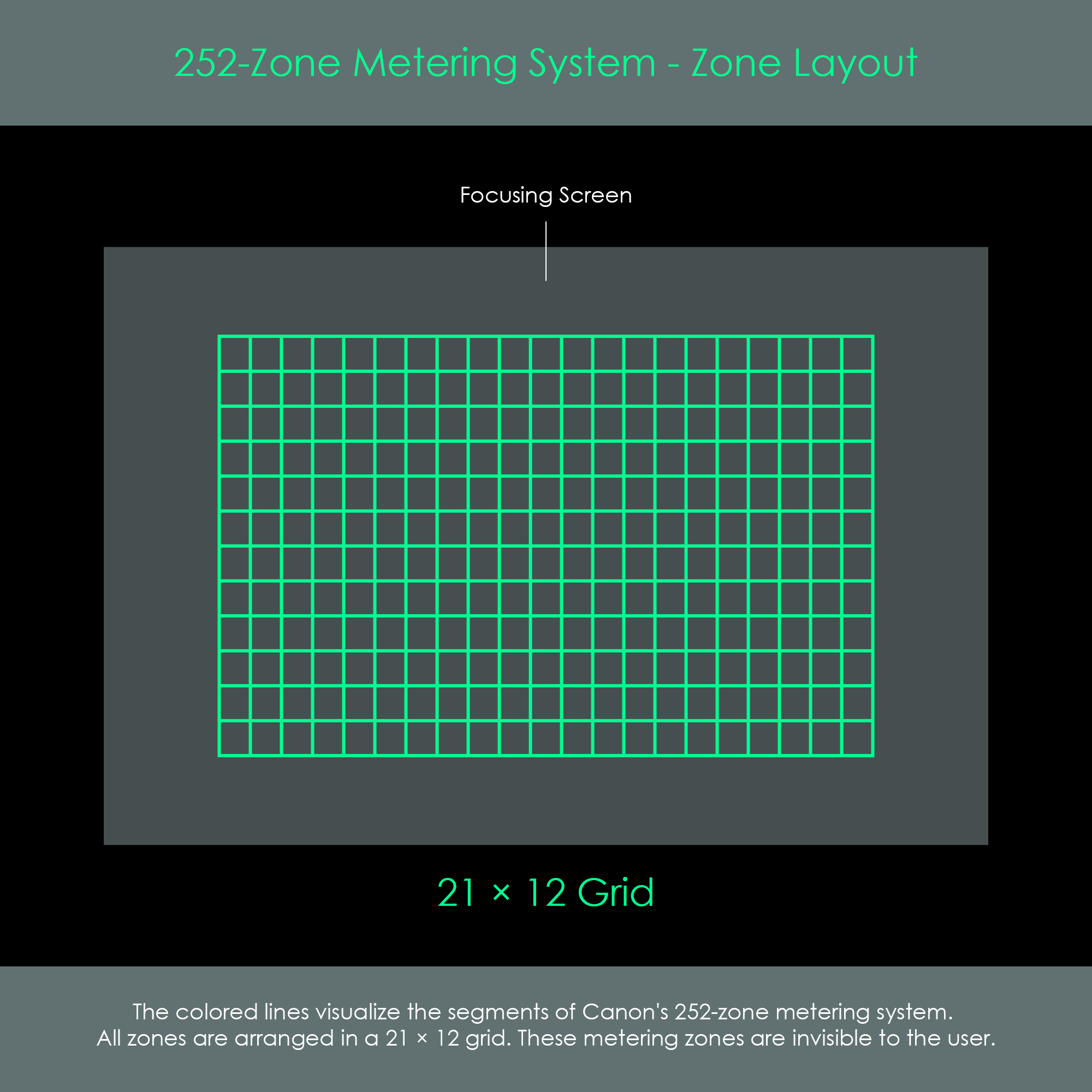
This system offers the following metering modes: 252-zone evaluative metering (linked to all autofocus points), partial metering (covering approximately 7% of the central picture area), spot metering (covering approximately 3% of the central picture area), and center-weighted average metering.
Canon intelligent Subject Analysis (iSA) is a dedicated scene-recognition and metering system. It feeds the image data recorded by the 100,000-pixel RGB sensor into the dedicated DIGIC 4 processor to analyze colors and light sources. This data automatically optimizes auto exposure, auto white balance, and autofocus tracking. When a dominant color is detected, the exposure is adjusted accordingly. Another iSA feature is the camera's ability to detect human faces during 61-point auto-selection autofocus.
Using the high-resolution metering sensor makes it possible to effectively detect, select, and track faces and colors that appear in the photographic scene. The iSA information is used by the iTR AF system to predict and select the most probable AF points within the selected AF area. When iSA detects a subject's face or color profile, iTR AF remembers the color of the subject where it first focused and then tracks that subject, continuously switching AF points to keep the subject in focus as is moves across the frame.
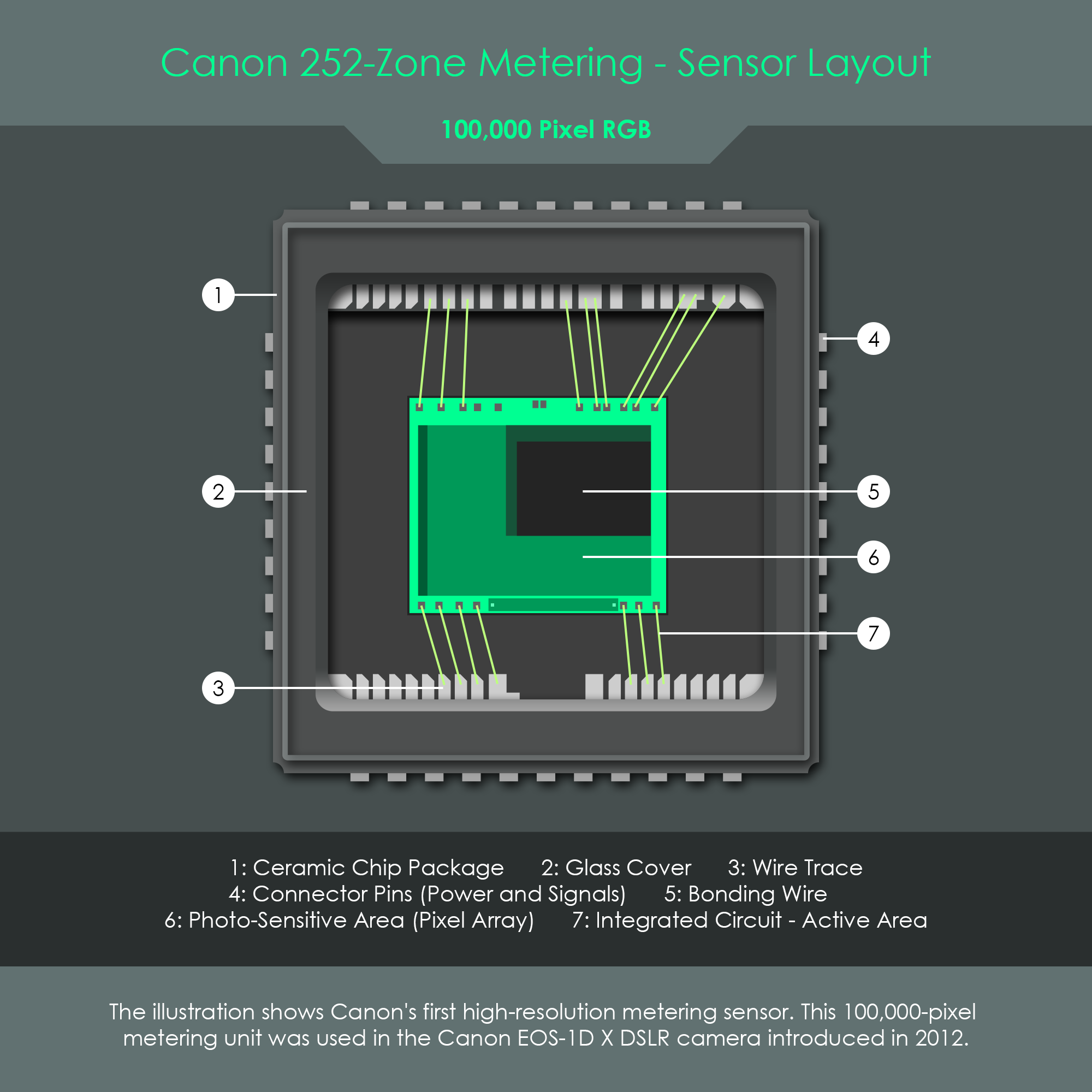
The sensor chip is placed inside a ceramic package with a protective glass cover applied on top. The integrated circuit's active area consists of an array of approximately 100,000 CMOS pixels capable of detecting the full spectrum of visible light (but no infrared). To achieve chromatic separation, a mosaic color filter array (CFA) is deposited directly onto the pixel surface. This array is structured into repeating four-pixel clusters configured in a standard Bayer pattern, where each cluster positions one red, one blue, and two green filters over individual photosites. The peripheral semiconductor substrate surrounding this active imaging area integrates the necessary analog-to-digital conversion, signal amplification, and digital image processing circuitry.
EV 0 - 20 at ISO 100.
Being the second EOS metering system using a high-resolution pixel array, this version came with an increased resolution of 150,000 RGB-sensitive pixels. The real innovation with this system was its capability to register near-infrared wavelengths of light.
The above listed cameras are also equipped with the EOS iSA (intelligent Subject Analysis) system that detects the subjects by face data and color information to enhance auto exposure, autofocus and auto white balance under different light sources. They also have the EOS iTR (intelligent Tracking Recognition) AF technology that uses face detection and color information from the EOS iSA system to track the recognized subject and keeps the subject in focus throughout the scene. The data-flow generated by this metering system as well as iSA and iTR AF algorithms are processed by a dedicated DIGIC 6 CPU.
This metering system again uses 252 metering zones of equal size. However, the layout of this version uses a grid of 18 columns and 14 rows. These metering zones are invisible to the user.
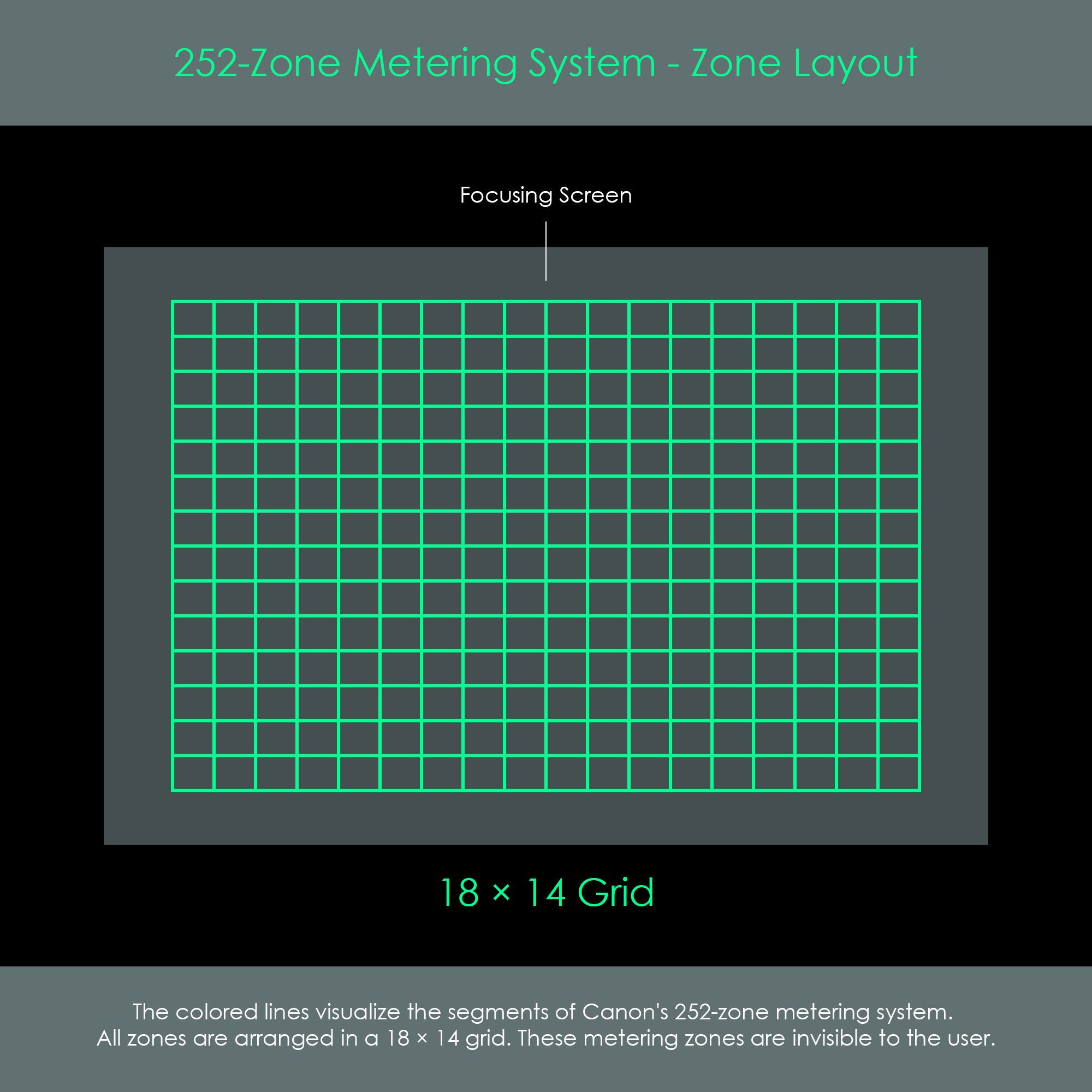
This system offers the following metering modes: 252-zone evaluative metering (linked to all autofocus points), partial metering (covering approximately 6% of the central picture area), spot metering (covering approximately 2% of the central picture area), and center-weighted average metering.
The RGB and infrared-detecting metering sensor offers an advanced level of light source analysis. There are two main advantages:
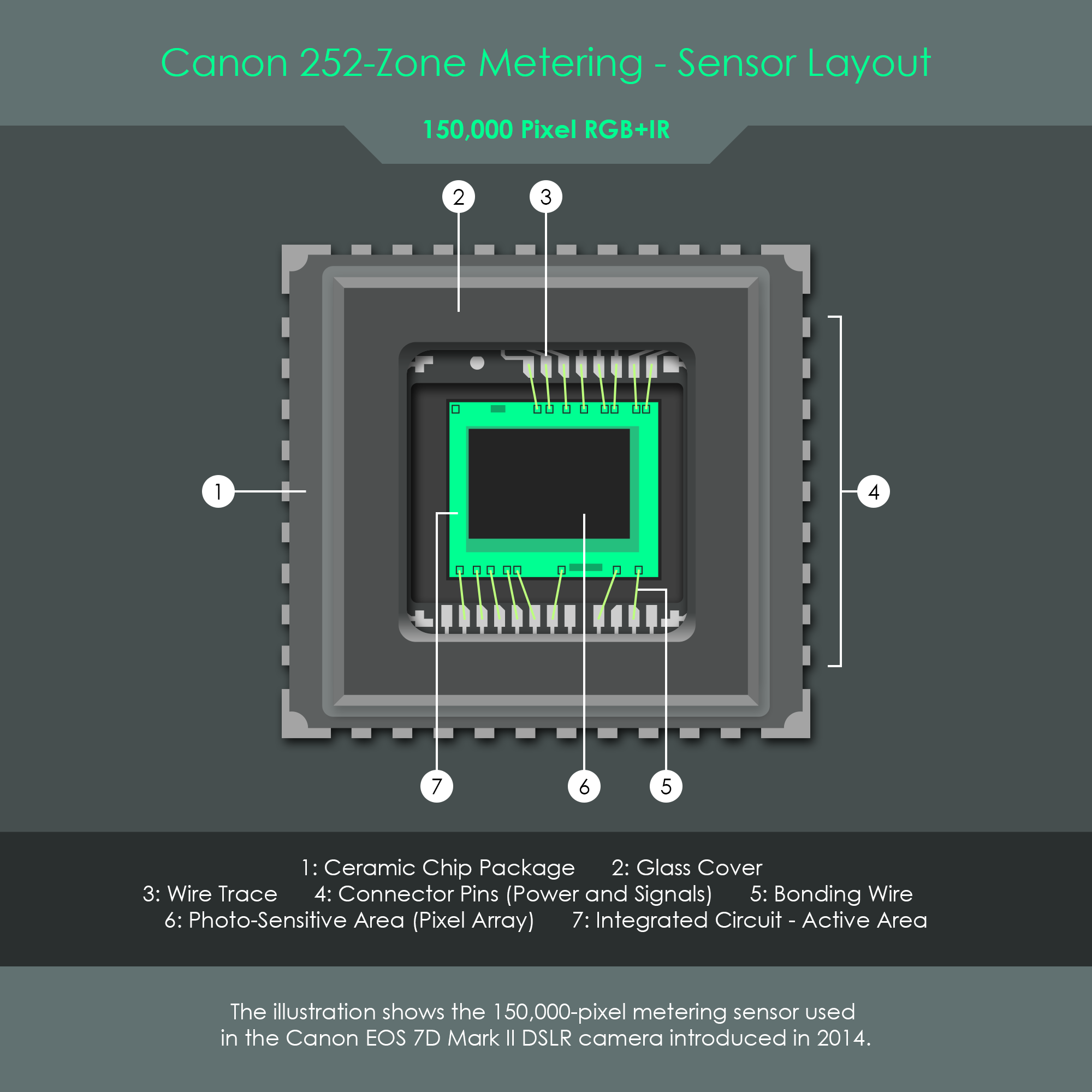
The sensor chip is placed inside a ceramic package with a protective glass cover applied on top. The integrated circuit's active area consists of an array of approximately 150,000 CMOS pixels capable of detecting the full spectrum of visible light as well as near-infrared (NIR) light. The RGB+IR technology typically uses a color filter mask that is applied to a monochrome sensor. In the case of conventional RGB sensors, four pixels always form a cluster, with one red filter, one blue filter, and two green filters placed in front of each photosite (pixel). With RGB+IR sensors, one of the two green pixels is usually replaced with an infrared (IR) pixel. This IR pixel contains red, green and blue filter materials, effectively absorbing all of the light in the visible spectrum. IR light with longer wavelengths will pass through this filter with minimal loss. This effectively creates 25% of all pixels with sensitivity to IR light. The semiconductor material surrounding the light-sensitive pixel array contains amplification and image-processing circuitry.
EV 0 - 20 at ISO 100.