An illustrated story about how Canon went from 6-zone metering sensors (1987) to their most advanced 216-zone 400,000-pixel RGB+IR metering systems (2020).






The 16-zone evaluative metering system offered a wide range of innovations. It was specifically designed for cameras having five autofocus points. Its zone segmentation is twice as fine as the previous 8-zone module. All cameras using the 16-zone evaluative metering system also have Canon's AIM (Advanced Integrated Multi-point Control) technology integrated. The AIM program detects which autofocus point is on the main subject (usually the nearest) and calculates exposure specifically for that subject. The exact range of features depends on the specific camera model.
In 1992, the Canon EOS 5 was introduced as the first camera with eye-controlled autofocus point selection (Eye-Control AF). This technology tracks the eye movements of the photographer and activates one of the five autofocus positions corresponding to the area where the photographer is looking at in the viewfinder. This eye-controlled autofocus feature is also linked to the 16-zone evaluative metering system which places particular emphasis on the area around the active autofocus point. However, in the Canon EOS 5, spot metering is limited to the central part of the viewfinder, and there is no fine spot metering available.
Two years later, the new EOS-1N as well as the EOS-1N RS professional SLR cameras offered several add-ons: A unique feature of these models is their ability to couple single spot metering zones with the active autofocus point. This offers true flexibility compared to most entry-level or mid-range EOS cameras, where spot metering is usually limited to the central autofocus point. Another feature only found in the EOS-1N and EOS-1N RS is fine spot metering, analyzing an area of the central viewfinder that is even smaller than the spot metering zone.
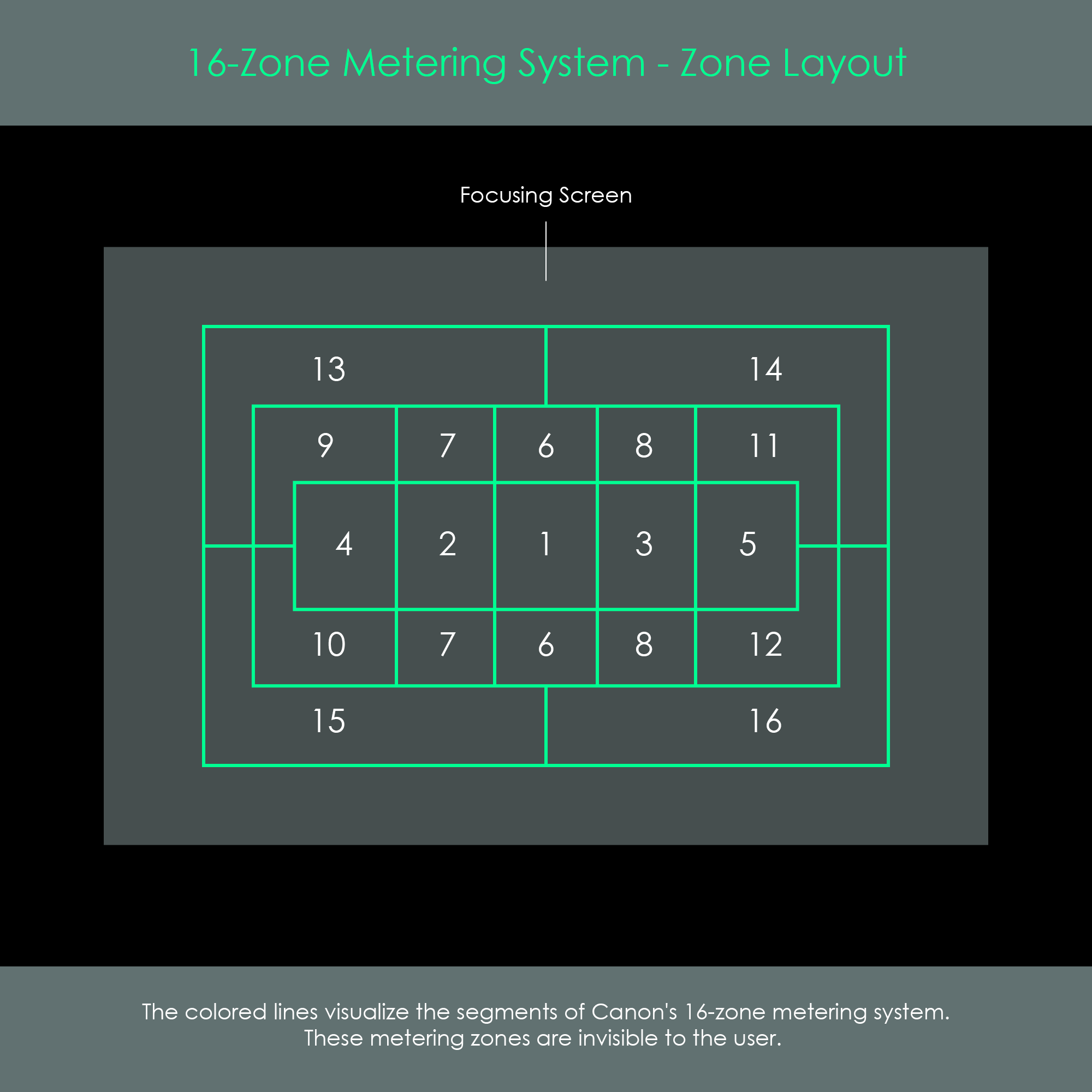
This zone layout has been specifically designed for EOS cameras with five autofocus points. Zones 1-5 are part of the main subject metering area. Intermediate metering area 6-12. Peripheral area 13-16. These metering zones are invisible to the user.
Here is a short excerpt about the 16-zone evaluative metering system, copied from the 1994 Special Issue of Canon's Professional Service Update where the Canon EOS-1N was introduced: The EOS-1N employs Canon's most advanced light metering system, featuring a 16-zone silicon photocell (SPC) sensor. The main microprocessor uses complex algorithms to evaluate luminance in each of the 16 zones. Differences in brightness are compared, allowing the camera to recognize a wide range of lighting situations, including difficult ones such as backlighting. And because the EOS-1N features Canon's AIM system, the active focusing point is taken as the central zone, ensuring that the exposure is based on readings from the main subject. Subject size and surrounding conditions are factored in to make the final exposure decision.
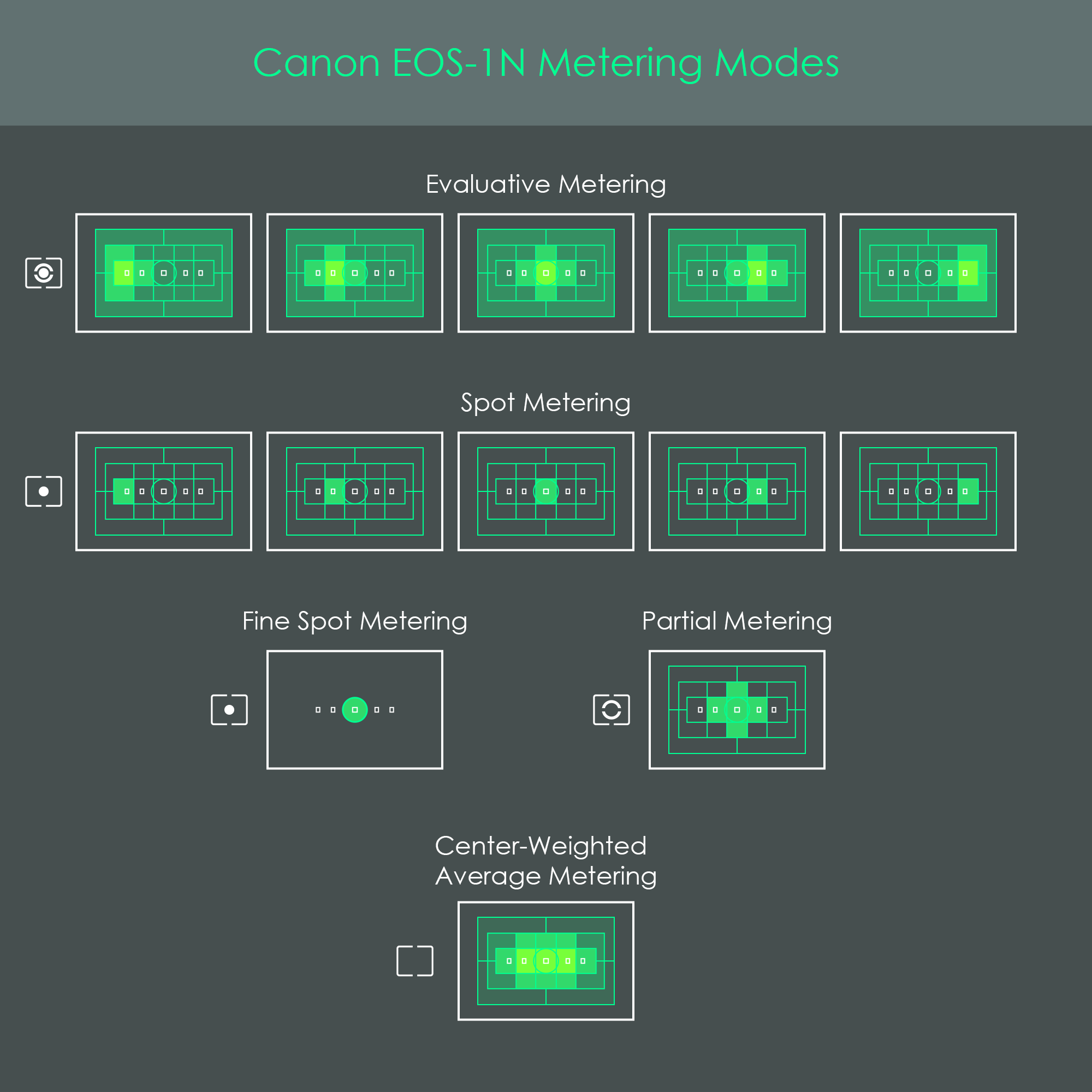
This 16-zone metering system offers the following metering modes:
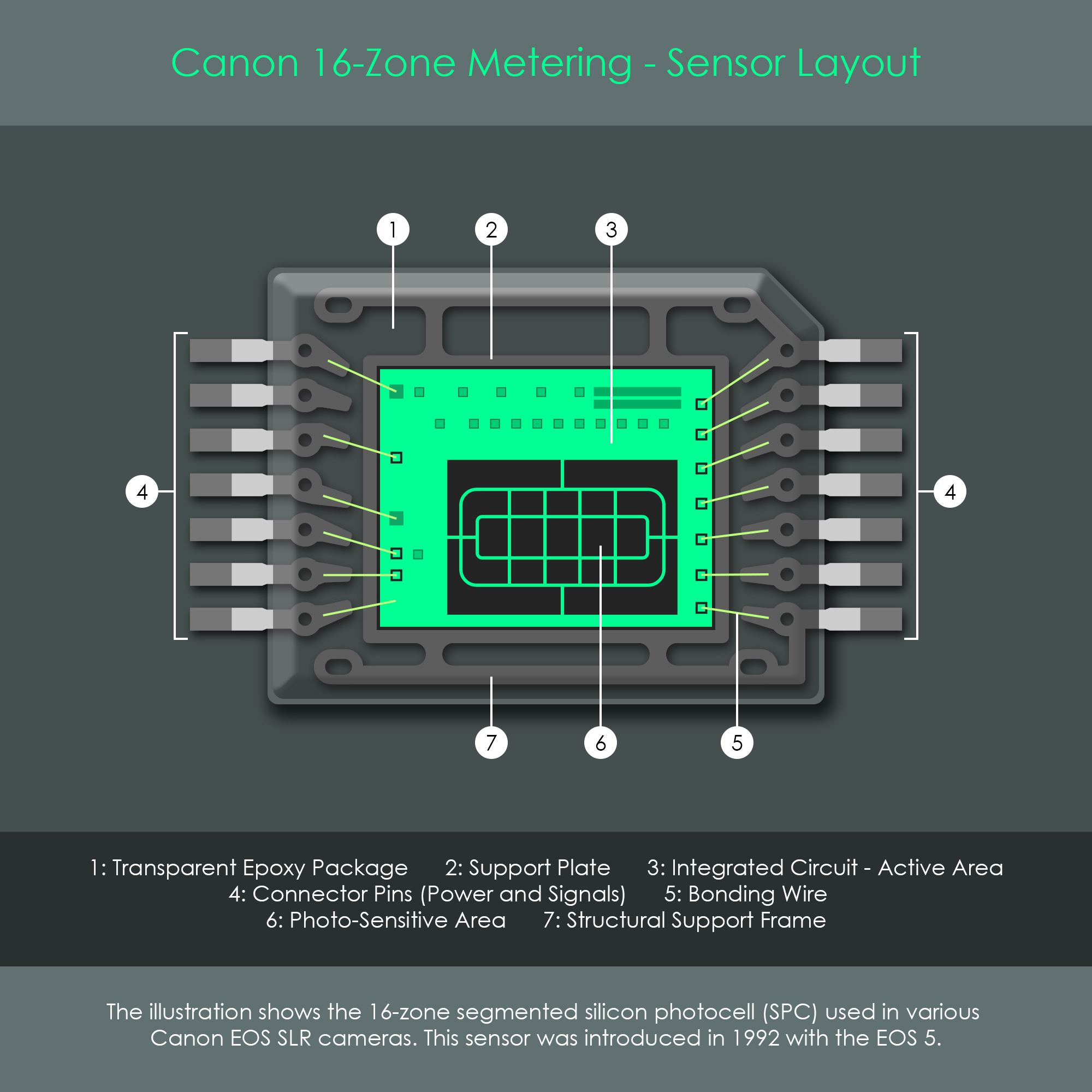
The overall sensor design is very similar to its predecessors. Support structures, connector pins, as well as the integrated circuit (IC) die are embedded inside a clear-molded package. This sensor uses a 16-zone segmented SPC (silicon photocell) as the actual light-sensitive element. Some of the IC's active area surrounding the SPC is used for signal amplification and processing. The amplification circuitry allows the camera to use auto-exposure metering even in low-light situations.